
Silence is not always golden in men’s health. In fact, silence often acts as your biggest enemy when dealing with prostate cancer. This disease ranks among the most common cancers globally. It affects millions of men every single year. Statistics show that one in eight men will face a prostate cancer diagnosis during their lifetime.
Despite these alarming numbers, a powerful beacon of hope exists. Doctors can easily cure prostate cancer if they catch it early. The challenge lies in how the disease begins. Early-stage prostate cancer is notoriously quiet. It starts without pain, without visible blood, and without dramatic health emergencies. The disease often progresses and spreads before it finally announces itself loudly.
As a premier medical tourism agency, Humane Medical Assistance wants to empower you with vital health information. We also guide international patients to the best possible care. This comprehensive guide breaks down the early signs of prostate cancer. We will explore late-stage red flags, critical risk factors, and proactive steps you can take today.
Key Takeaways on Prostate Cancer
- What is it? A type of cancer that grows in the prostate. This small, walnut-shaped gland produces seminal fluid in men.
- Early Signs: Frequent nighttime urination, weak urine flow, difficulty starting urination, and a feeling of an unemptied bladder.
- Late Signs: Blood in urine or semen, unexplained weight loss, bone pain, and sudden erectile dysfunction.
- High-Risk Groups: Men over 50, individuals with a family history, people eating high-fat diets, and men of African descent.
- Action Plan: Schedule regular screenings. Get a PSA blood test and a physical exam if you are over 50 or at high risk.
The Anatomy of the Problem: Understanding the Prostate
You must understand what the prostate does before looking at the symptoms. The prostate is a small gland located just below the bladder. It sits right in front of the rectum. The gland wraps around the urethra. The urethra is the tube that carries urine from your bladder and out of your body.
How Cancer Develops
Abnormal cells sometimes form in the prostate. These cells multiply out of control and create a tumor. The earliest physical signs of a growing tumor almost always involve changes in your urinary habits. This happens because the prostate wraps directly around your urinary tract.
The Aging Factor
The prostate naturally grows larger as men age. Doctors call this non-cancerous growth Benign Prostatic Hyperplasia (BPH). Unfortunately, many men confuse cancer symptoms with this normal aging process. They ignore vital early warning signs. You should never assume urinary changes are just a normal part of getting older.
The Silent Phase: Early Warning Signs You Shouldn’t Ignore
Noticing subtle changes in your body can save your life. Medical professionals urge men to take early urinary symptoms seriously. You should consult a doctor right away if you experience any of the following issues.
1. Urgent Nighttime Urination (Nocturia)
Waking up once a night to pee is usually normal. This is especially true if you drink water right before bed. However, waking up multiple times with a sudden urge to urinate serves as a major red flag. A growing tumor presses against your bladder. This pressure reduces your bladder’s capacity and makes it feel full prematurely.
2. Weak or Interrupted Urine Flow
Does your urine stream lack its usual force? Does it stop and start involuntarily? These changes point toward a physical blockage. A growing prostate tumor squeezes the urethra. This restriction stops the natural, steady flow of urine.
3. Difficulty Starting or Stopping Urination
Hesitancy is a classic symptom of a prostate issue. You might stand at the toilet and wait for the flow to begin despite feeling the urge. You might also experience “dribbling” after you feel you have finished. Both issues mean something is compromising your urethral pathway.
4. A Bladder That Feels Full
You might feel a persistent, uncomfortable sensation after using the restroom. This happens when a blockage prevents your bladder from emptying completely. This leftover urine causes discomfort. It also creates a breeding ground for painful urinary tract infections.
5. Burning or Discomfort When Peeing
People often associate burning urination with infections. However, this discomfort also acts as an early indicator of prostate inflammation or cancer. You should ask a medical professional to evaluate any pain associated with basic bodily functions.
Red Flags: Later Signs of Advancing Prostate Cancer
Prostate cancer becomes much more dangerous when it moves beyond the early stages. The disease can spread to other parts of the body. Doctors call this spreading process metastasis. The symptoms become severe and highly noticeable during this phase. You need immediate medical intervention if you experience these late-stage signs.
Blood in Your Urine or Semen
Seeing blood in your bodily fluids is never normal. Doctors call this hematuria. It means the tumor has reached nearby blood vessels. The cancer might have invaded the bladder or the urethra.
Unexplained Weight Loss
Are you losing weight rapidly without trying? This systemic sign means your body is fighting a severe illness. Cancer burns massive amounts of energy. You must investigate sudden weight loss immediately.
Sudden Erectile Dysfunction
Many things cause erectile dysfunction (ED). Stress, diabetes, and heart problems all play a role. However, a sudden inability to get an erection is alarming. Advanced prostate cancer damages the delicate nerves and blood vessels surrounding the gland.
Severe Bone Pain
Prostate cancer frequently spreads to the bones. Tumors often target the spine, hips, and pelvis. Patients describe this pain as a deep, relentless ache. Resting does not help. Over-the-counter pain medications rarely provide relief.
Persistent Lower Body Stiffness
You might feel unrelenting stiffness in your lower back or hips. This specific lower body pain serves as a hallmark sign of advanced disease. It strongly suggests the cancer has left the localized prostate area.
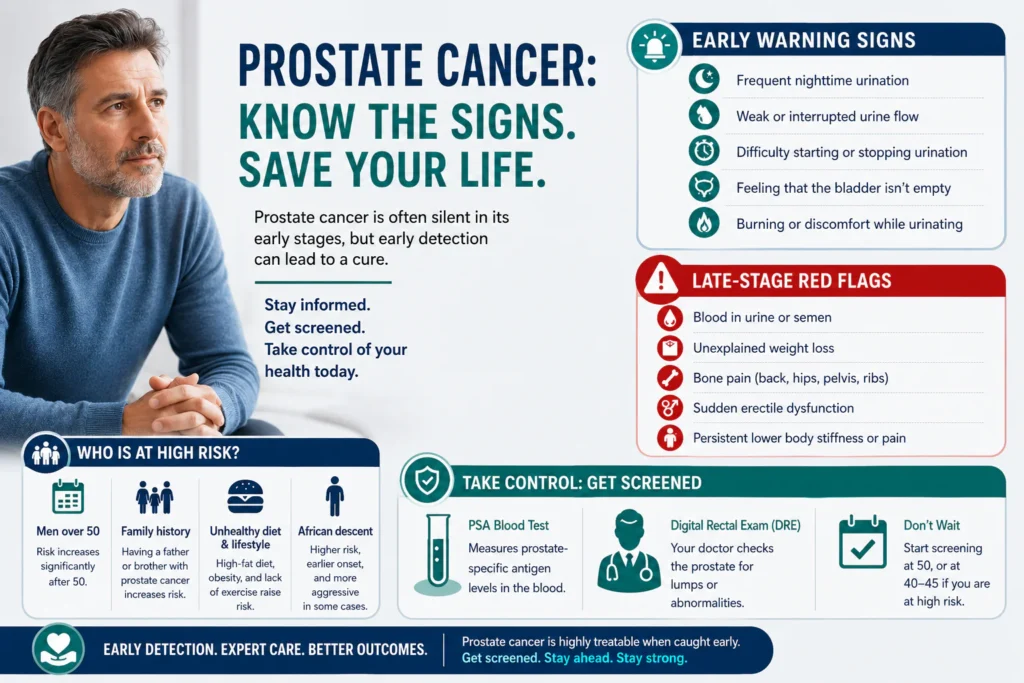
Identifying Your Vulnerability: Who Faces the Highest Risk?
Prostate cancer can affect any man. However, certain demographic and lifestyle factors elevate your risk significantly. You belong to a high-risk group if you meet three or more of the following criteria. You should pursue aggressive, early screening protocols if this applies to you.
Age and Genetics
Your risk of prostate cancer jumps significantly after you turn 50. Routine screenings must become a mandatory part of your annual health check-ups at this milestone. Genetics also play a massive role. Your risk doubles if your father or brother had prostate cancer. The danger increases even more if doctors diagnosed your relative at a young age.
Lifestyle and Diet Choices
Poor diets link directly to higher rates of aggressive prostate cancer. You increase your risk by eating lots of processed foods, red meats, and high-fat dairy. A lack of exercise compounds this problem. Men carrying excess weight face a higher danger. Visceral fat around the midsection makes men more likely to develop harder-to-treat forms of the disease.
Race and Ethnicity
Black men face a much higher threat. They are twice as likely to receive a prostate cancer diagnosis compared to other races. The disease also manifests earlier in men of African descent. It tends to behave more aggressively as well. This makes early and frequent screening absolutely vital for this demographic.
Proactive Steps: Screening and Taking Control
Prevention beats seeking a cure for advanced disease every time. You need to advocate for your health. High-risk men must ask their healthcare providers for the following tests.
1. Get a PSA Blood Test
This simple blood test measures your Prostate-Specific Antigen (PSA) levels. The prostate produces this specific protein. High levels point toward cancer, infection, or general enlargement.
2. Schedule a Physical Exam
Doctors recommend a Digital Rectal Exam (DRE) for men over 50. High-risk men should start at age 40. This quick physical exam allows your doctor to feel the prostate directly. They check for hard lumps or unusual abnormalities.
3. Do Not Wait for Symptoms
Never wait until you feel sick to get checked. Start having conversations about prostate health in your early 40s. Proactive screening saves thousands of lives every year.

Seeking World-Class Treatment: How We Help
Hearing a cancer diagnosis feels overwhelming. Finding the right treatment should not add to your heavy burden. India now stands as a global hub for advanced oncology. The country offers state-of-the-art medical infrastructure and highly skilled robotic surgeons. Patients access cutting-edge radiation therapies at a fraction of Western costs.
Why Choose Medical Tourism?
Humane Medical Assistance understands the stress of cross-border healthcare. We work as your comprehensive healthcare facilitation partner. We do not operate as a hospital. Instead, we bridge the gap between international patients and India’s top-tier oncology centers. We ensure you receive care that matches global medical standards.
Our Support Services
We connect you with renowned Indian urologists for secondary evaluations. Our team helps you plan your treatment step-by-step. We facilitate medical visa invitations to ensure smooth travel. We also coordinate your hospital appointments, admissions, and post-operative care. Our on-the-ground support team handles the logistics so you can focus entirely on healing.
You might need a robotic surgery or targeted radiation therapy. We ensure you access world-class medical expertise without the traditional logistical stress.
Frequently Asked Questions
Can doctors cure prostate cancer if they catch it early? Yes. Localized prostate cancer has a 5-year survival rate of nearly 100%. Early detection through PSA testing provides the best chance for a total cure.
Does a high PSA level always mean I have cancer? No. An enlarged prostate or an infection can also cause high PSA levels. Even vigorous exercise raises your numbers temporarily. However, a high score requires follow-up testing like an MRI to rule out cancer.
At what age should I start checking my prostate? Men with an average risk should start screening at age 50. High-risk men should begin talking to their doctors between ages 40 and 45.
Does early-stage prostate cancer hurt? Usually, no. Early-stage prostate cancer stays silent and rarely causes pain. Symptoms only appear when the tumor grows large enough to block your urine flow.
Why do international patients choose India for treatment? India offers globally recognized oncologists and the latest robotic surgical tools. Patients receive excellent care at highly competitive costs. Agencies like Humane Medical Assistance make the travel and treatment process seamless.