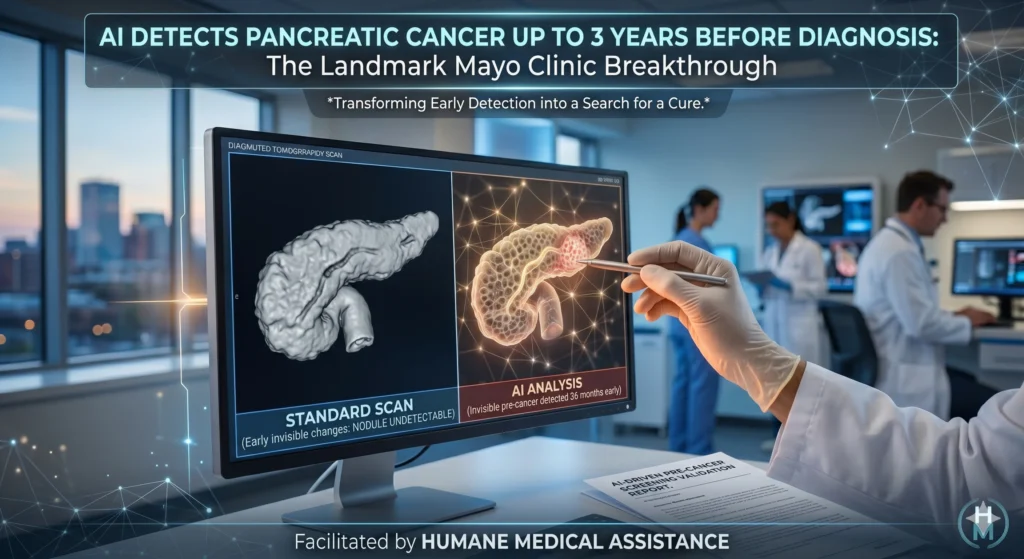
Of all the complex challenges in modern oncology, few seem as daunting as pancreatic cancer. For decades, this disease has remained formidable and elusive. It frequently evades detection until it reaches an advanced, highly dangerous stage. The pancreas sits deep within the abdominal cavity. Therefore, patients cannot feel early tumors. Standard imaging also struggles to capture them.
However, the landscape of oncological diagnostics stands on the edge of a technological revolution. The Mayo Clinic recently published a landmark validation study. Researchers unveiled an Artificial Intelligence (AI) model. This tool can detect pancreatic cancer up to three years before a standard clinical diagnosis. This breakthrough represents a fundamental shift. It transforms how the global medical community approaches early detection and survival.
At Humane Medical Assistance, our mission is simple. We keep you informed about advanced medical breakthroughs. We also connect you with the highest tiers of global healthcare. This article explores the complexities of pancreatic cancer. We explain how this groundbreaking AI technology works. Finally, we discuss its meaning for the future of patient care.
The Silent Challenge of Pancreatic Cancer
You must understand the biological challenges of this disease to appreciate this AI breakthrough. The pancreas is a spongy, six-inch-long organ behind the stomach. It digests food and manages your blood sugar. A tumor forms when healthy cells mutate and grow out of control.
The devastating reality of pancreatic cancer involves its silent growth. Early-stage tumors almost never cause symptoms. Eventually, a patient begins to experience classic warning signs. These include unexplained weight loss, jaundice, abdominal pain, and sudden-onset diabetes. By this time, the cancer has usually grown significantly. It often metastasizes to surrounding organs like the liver or lungs.
The Urgent Need for Early Detection
Doctors frequently catch pancreatic cancer in these late stages. Consequently, it carries one of the lowest survival rates of all major cancers. Surgical removal often becomes impossible once the disease spreads. This leaves patients with limited therapeutic pathways.
The medical community knows early detection drastically improves survival rates. However, finding a highly sensitive diagnostic tool remained the ultimate hurdle.
The AI Breakthrough: Seeing the Invisible
The Mayo Clinic recently introduced a tool that acts as superhuman eyes. Researchers developed a highly sophisticated AI algorithm. They trained it specifically to analyze abdominal computed tomography (CT) scans.
Doctors currently use standard CT scans to visualize internal organs. However, human radiologists face limits based on human perception. Early-stage pancreatic cancer tumors look microscopic. They blend seamlessly into surrounding healthy tissue.
How the Algorithm Changes the Game
Here is how the new AI model transforms diagnostics:
- Learning from Massive Datasets: Researchers trained the AI on a vast archive of historical CT scans. The algorithm analyzed thousands of images. It learned to recognize the most subtle, pre-cancerous tissue changes.
- Identifying Microscopic Patterns: The AI does not just look for a visible lump. It analyzes the texture, density, and microscopic patterns of the pancreas. It flags abnormalities long before a distinct tumor forms.
- Predicting Future Risk: The AI can analyze a routine CT scan taken for an unrelated reason. It spots invisible clues. It then flags the patient as having an exceptionally high risk for pancreatic cancer.
The Landmark Validation Study: Proving the Concept
Developing an AI model is only the first step. Proving its real-world accuracy represents the true test. This fact makes the Mayo Clinic’s recent findings a landmark study.
Researchers needed to validate the algorithm. They tested it against a massive, independent patient dataset. They fed the AI historical CT scans from diverse individuals. Some of these people eventually developed pancreatic cancer. Others remained completely healthy.
Staggering Predictive Results
The results staggered the medical community. The AI model successfully predicted which patients would develop the disease. It identified invisible warning signs on older CT scans. Technicians had taken these scans 12 to 36 months before official clinical diagnoses.
This AI model drastically outperforms current standards. It detects microscopic precursors to pancreatic cancer up to three years early. Biological breadcrumbs exist long before the tumor threatens a patient’s life. Medical science simply needed the right technological lens to see them.
Shifting the Survival Paradigm
Catching pancreatic cancer early carries massive implications. In oncology, time serves as the ultimate currency. Currently, most diagnoses happen at an advanced stage. Therefore, the five-year survival rate lingers around a heartbreaking 13%.
However, early detection changes a patient’s prognosis entirely. Doctors must catch the cancer at a localized stage. This means the tumor remains small and strictly confined to the pancreas. Early detection makes the tumor highly resectable (removable).
Surgeons can remove the tumor successfully. Oncologists then apply modern, targeted chemotherapies. This combination exponentially increases the chances of long-term survival. Total remission becomes a real possibility.
This AI technology offers tremendous hope. It can shift how we view pancreatic cancer. We may soon see it as a manageable and treatable condition. It could become curable for thousands of individuals worldwide.
The Future of Clinical Rollout
This validation study provides an incredible victory for medical science. However, standard diagnostic centers do not yet offer this specific AI model.
The next phase involves prospective clinical trials. Medical institutions will deploy the AI in real-time patient care settings. Researchers will carefully monitor its effectiveness. They must ensure it meets strict global regulatory standards before widespread release.
The rapid pace of AI integration offers encouragement. This technology will soon become a gold standard in top-tier international oncology centers.

Navigating Global Oncology with Humane Medical Assistance
You might face a high-risk diagnosis. You might seek the most advanced preventative screenings. Relying solely on localized healthcare systems limits your options. You might miss out on cutting-edge technologies.
Accessing new AI-driven tools at global institutions feels overwhelming. Humane Medical Assistance serves as your vital bridge to world-class care. We operate as a dedicated medical facilitation agency. We break down international borders to connect you with authoritative medical minds.
How We Facilitate Your Access:
- Global Oncology Connections: We maintain strong networks with premier international cancer centers. We connect you with renowned oncologists leading early detection research.
- Expert Second Opinions: We facilitate remote consultations with global experts. They review your files and provide definitive second opinions before you travel.
- Seamless Care Logistics: Traveling for medical care demands precision. Our team manages every administrative burden. We secure medical visas and arrange specialized flights.
- Tailored Treatment Pathways: We match you with the best international facility for your specific needs. You gain access to advanced robotic surgery or cutting-edge clinical trials.
A New Era of Hope
The fight against pancreatic cancer enters a new era of hope. Artificial intelligence and early detection drive this progress. You do not have to navigate this complex landscape alone.
Humane Medical Assistance guides you every step of the way. We manage your path to health with compassion, expertise, and precision.