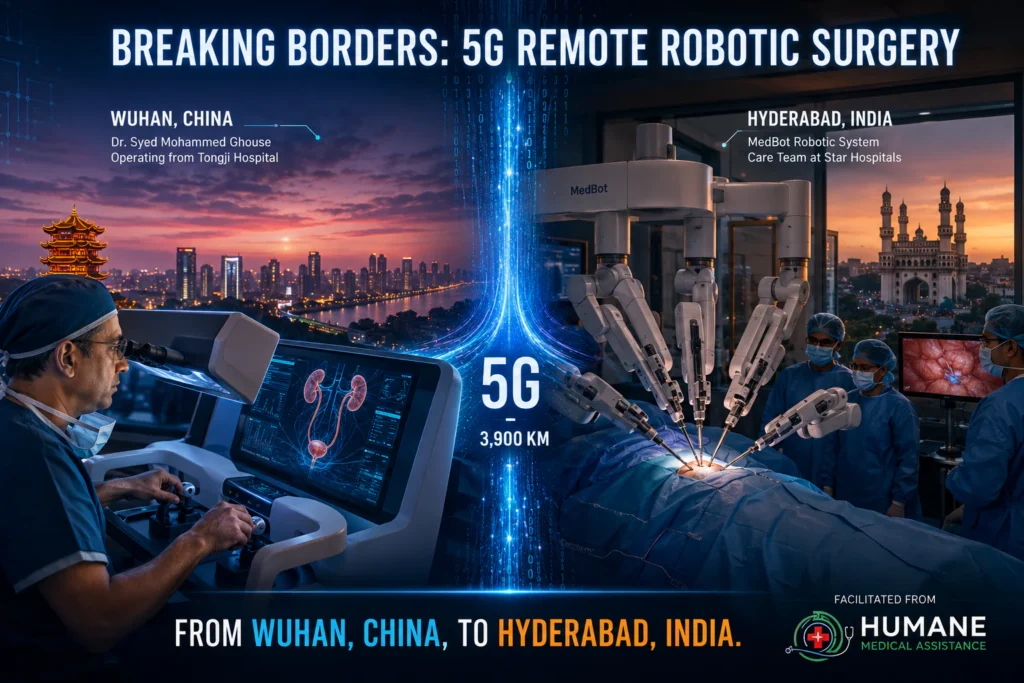
The future of healthcare no longer ends at the hospital door. Furthermore, it easily crosses international borders. In May 2026, an Indian urologist stationed in Wuhan, China, achieved a groundbreaking medical milestone. He successfully performed a complex remote robotic surgery. Specifically, his patient was located nearly 3,000 kilometers away in Hyderabad, India.
The medical team leveraged cutting-edge 5G telecommunications and advanced robotic systems. Consequently, this transcontinental operation proved a major point. Doctors can deliver high-precision surgical care globally. By bridging the physical gap between specialized experts and patients in need, this milestone redefines modern medicine.
Therefore, this comprehensive guide explores the details of this historic cross-border surgery. Next, we break down the 5G and robotic technologies behind it. Finally, we examine how telesurgery impacts the future of global medical tourism and healthcare.
The Historic Surgery: A 3,000 KM Medical Marvel
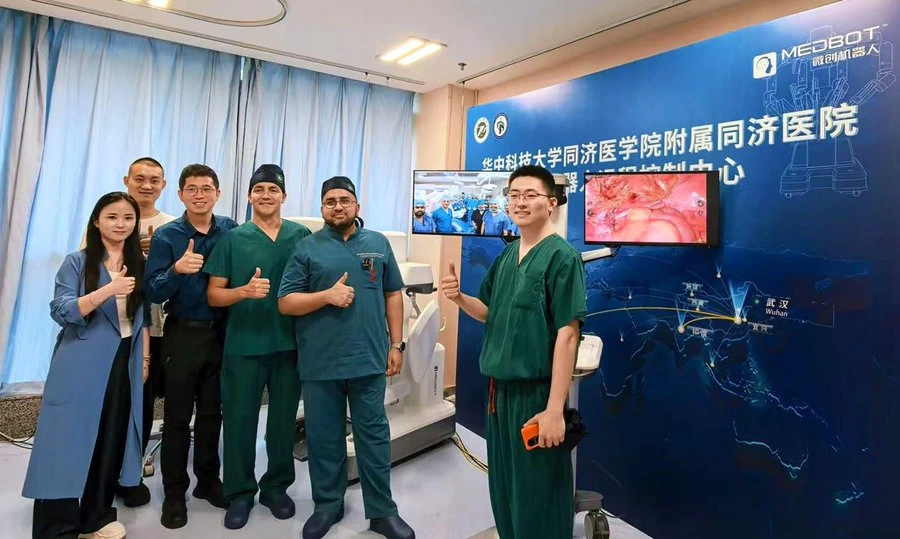
On May 18, 2026, Dr. Syed Mohammed Ghouse sat down at a surgical console. He serves as the Director of Robotic Urological Surgery at the Asian Institute of Nephrology and Urology (AINU) in Hyderabad. However, Dr. Ghouse was not actually in India at the time. Instead, he worked from Tongji Hospital in Wuhan, China. He was attending an international medical congress there.
Meanwhile, his 57-year-old female patient rested in a Hyderabad operating theater. She suffered from a recurrent lower ureteric obstruction. A stricture from a previous surgery caused this painful issue. First, doctors tried using temporary stents. Unfortunately, these failed to provide lasting relief. As a result, the medical team planned an anti-reflux ureteric reimplantation. This specific procedure reconnects the blocked tube directly to the urinary bladder. Ultimately, this surgery restores normal urine flow safely.
A Seamless International Collaboration
Precise, real-time coordination between two medical teams guaranteed success. Consequently, the teams executed the 90-minute procedure flawlessly.
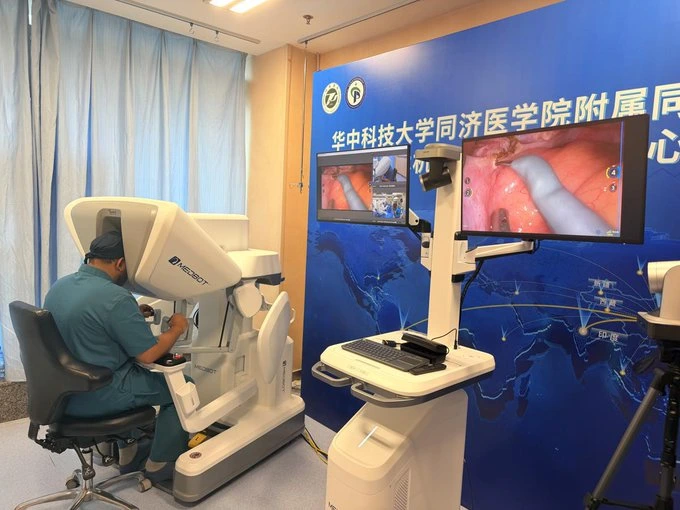
- The Wuhan Team: Dr. Ghouse operated the master console at Tongji Hospital. He guided the surgical instruments smoothly. To do this, he used magnified, real-time 3D high-definition visuals.
- The Hyderabad Team: Simultaneously, a specialized local team worked in India. Uro-surgeons, anesthetists, and nurses prepared the patient carefully. They administered anesthesia and safely positioned the Toumai robotic surgical system. Medbot developed this advanced equipment.
The doctors operated over a distance of roughly 3,000 kilometers. Incredibly, the robotic arms in India instantly replicated Dr. Ghouse’s hand movements in China. Following the procedure, the patient recovered rapidly. In fact, doctors discharged her on the exact same day. This quick recovery highlights the minimally invasive benefits of robotic surgery. Furthermore, it showcases the immense precision of a master surgeon.
What is Remote Robotic Surgery?
Direct Answer: Remote robotic surgery, or telesurgery, represents a modern medical breakthrough. During this procedure, a surgeon performs an operation on a patient from afar. The doctor might sit in a completely different room, city, or country.
To succeed, the process utilizes advanced robotic surgical platforms and high-definition 3D video streaming. Additionally, it relies heavily on ultra-fast telecommunications networks like 5G. These tools work together seamlessly. They translate the surgeon’s hand movements into precise robotic actions in real time. Traditionally, robotic systems require the surgeon to stay inside the same operating room. However, telesurgery completely extends this concept. Therefore, it proves that physical distance no longer limits specialized patient care.
How Does 5G Robotic Surgery Work?
How can a doctor in China operate on an Indian patient without noticeable delay?
To understand this, we must break down the telesurgery setup. Specifically, the system relies on three distinct pillars.
- The Surgeon’s Console: First, the operating surgeon sits at an ergonomic command center. The doctor looks through a binocular-style viewer. This viewer provides an immersive 3D look at the patient’s internal organs. Next, the surgeon manipulates specialized manual controls. These controls possess millimeter-level precision.
- The Patient Cart: Second, a cart stands next to the patient. It features multiple articulating robotic arms. During the Hyderabad procedure, these arms held miniature surgical instruments. They mimicked the surgeon’s exact movements perfectly. Moreover, the system filtered out human hand tremors to ensure unparalleled stability.
- The Telecommunications Link: Finally, an invisible digital bridge holds the operation together. The internet connection plays a crucial role here. 5G networks transmitted the high-definition video feed quickly. They also sent mechanical instructions across the Asian continent. Impressively, this data transfer took less than 200 milliseconds.
The Technological Backbone: Why 5G is the Game-Changer
For decades, a single hurdle stifled the concept of telesurgery. That hurdle is latency. Latency measures the time data takes to travel from the console to the robot and back. In surgery, a millimeter mistake can sever a blood vessel. Therefore, system lag remains incredibly dangerous.
Older 4G networks simply could not guarantee the necessary ultra-low latency. Fortunately, the integration of 5G communications has solved this massive problem. Specifically, 5G offers several major advantages:
- Ultra-Low Latency: Data transmission occurs in near real-time. This speed keeps round-trip delays safely under the critical 200-millisecond threshold.
- High Bandwidth: The network handles massive data loads effortlessly. For instance, it streams stereoscopic 3D video without buffering.
- Reliability: Furthermore, 5G provides exceptionally stable connections. This reliability actively reduces the risk of packet loss. Consequently, it prevents dangerous visual stuttering during operations.
Safety First: What Happens if the Internet Drops?
Many people ask about the worst-case scenario. What happens if the internet disconnects while a robotic arm operates inside a patient? To address this, engineers build telesurgery systems with intense fail-safes.
| Safety Protocol | Description |
| Network Redundancy | Hospitals utilize multiple simultaneous leased broadband lines. If the primary 5G line fails, a secondary backup line automatically takes over. |
| Automatic Standby | Sometimes, a total network failure occurs. If so, the robotic arms immediately freeze in place. This action actively protects the patient’s internal organs. |
| Local Medical Backup | A fully scrubbed, highly trained local team stands beside the patient. Consequently, they can seamlessly step in. They will complete the operation manually if needed. |
| Two-Way Audio | Constant, zero-lag bidirectional audio exists. This allows the remote surgeon to speak with on-ground assistants freely. It feels exactly as if they share the same physical room. |
The Global Impact on Medical Tourism and Healthcare Logistics
The success of this transcontinental procedure represents more than a technical milestone. Indeed, it previews an entirely new era of equitable global healthcare. Cross-border treatments are becoming increasingly viable. Therefore, the logistical framework supporting international patients must adapt quickly.
Currently, medical tourism relies heavily on physical travel. Patients travel vast distances to reach regional healthcare hubs. For example, India serves as a premier destination for international patients. Many travelers come from Africa and the Middle East. Often, they seek advanced oncology or specialized surgeries in major centers like New Delhi.
As telesurgery matures, dedicated medical tourism agencies will shift their focus. They will move from merely coordinating travel to facilitating complex clinical linkages. For instance, organizations like Humane Medical Assistance connect global patients with India’s top-tier medical infrastructure. This New Delhi-based international service focuses entirely on patient advocacy and streamlined coordination. They do not operate as a singular hospital. Because of this, they are perfectly positioned to orchestrate multi-layered telesurgery logistics.
First, they might secure the necessary network bandwidth at a local partner clinic in Cameroon. Next, they could establish a master console hub in Okhla. All the while, the patient remains safely in their home country. Ultimately, facilitation agencies will become the connective tissue of this new borderless medical ecosystem.
Frequently Asked Questions
What is the maximum distance for remote robotic surgery?
Currently, no strict maximum distance exists. The telecommunications network simply needs to maintain a latency under 200 milliseconds. Surgeons have successfully performed operations across 8,500 kilometers. For example, doctors connected France and India using high-speed fiber optic and 5G networks.
Is remote robotic surgery safe?
Yes, remote robotic surgery remains highly safe. Doctors utilize the exact same FDA-approved robotic systems used in local surgeries. Additionally, hospitals implement extensive safety protocols. Backup internet lines and an experienced on-ground surgical team ensure maximum patient protection.
Who controls the robot during Robotic Surgery?
A specialized human surgeon completely controls the robot. The doctor sits at a remote console. Importantly, the robot never operates autonomously. It strictly mirrors the real-time hand and finger movements of the human expert.
What kind of surgeries can doctors do remotely?
Currently, doctors use telesurgery for highly precise, minimally invasive procedures. This list includes urological surgeries, such as prostatectomies and ureteral reimplantations. Furthermore, surgeons perform gastrointestinal surgeries, bariatric procedures, and certain cardiac operations remotely.
How does 5G improve robotic surgery?
5G significantly lowers network latency. It eliminates the delay between command and action. Moreover, it massively increases bandwidth capacity. This technology allows for the instant transmission of high-resolution 3D video. Ultimately, it ensures the remote surgeon experiences no perceptible lag while operating.