When you or a loved one receives a diagnosis of end-stage liver disease, the world immediately narrows. The focus shifts entirely to survival, hope, and finding the best possible medical intervention. For patients in the United States, the United Kingdom, Africa, the Middle East, and parts of Asia, this search often reveals a grim reality: multi-year waitlists for deceased donor organs and astronomical, often prohibitive, healthcare costs.
However, a beacon of hope has firmly established itself on the global medical map. According to a landmark report published in The National Medical Journal of India (NMJI) by leading hepatobiliary experts Dr. Parmanand Tiwari and Dr. Samiran Nundy, India has transformed from a nation with no liver transplant services in the late 1980s to a commanding global superpower in hepatobiliary sciences today.
If you are an international patient seeking a second chance at life, here is a comprehensive, data-driven look at why India should be your premier destination for a liver transplant.
The Global Liver Crisis and the Search for Viable Solutions
Liver failure whether caused by Non-alcoholic steatohepatitis (NASH), alcoholic cirrhosis, or viral infections like Hepatitis B and C is a ticking clock. In many Western nations, the organ allocation system relies heavily on deceased (cadaveric) donations. Because the demand for healthy livers vastly outpaces the supply, patients are placed on the MELD (Model for End-Stage Liver Disease) waitlist. Tragically, many patients deteriorate before an organ becomes available.
Furthermore, international transplant laws make it incredibly difficult, if not impossible, for foreign nationals to receive a deceased donor organ in another country, as citizens of that country are rightfully prioritized.
The solution to this global bottleneck is the Living Donor Liver Transplant (LDLT). Because the human liver has the miraculous ability to regenerate, a healthy relative can donate a portion of their liver to the patient. Both the donor’s and the recipient’s livers will grow back to near-normal size within weeks.
For international patients, an LDLT with a related donor is the most viable, immediate, and life-saving option. And when it comes to LDLT, no country on earth compares to India.
Why Choose India? The NMJI Statistics Speak for Themselves
When traveling across borders for highly complex, high-stakes surgery, you need absolute certainty in the surgical team’s expertise. In surgery, volume dictates mastery. The more a surgical team performs a specific procedure, the better their outcomes, complication management, and graft survival rates.
The recent publication in the National Medical Journal of India provides stunning statistical validation of India’s transplant prowess:
1. Global Leadership in Volume
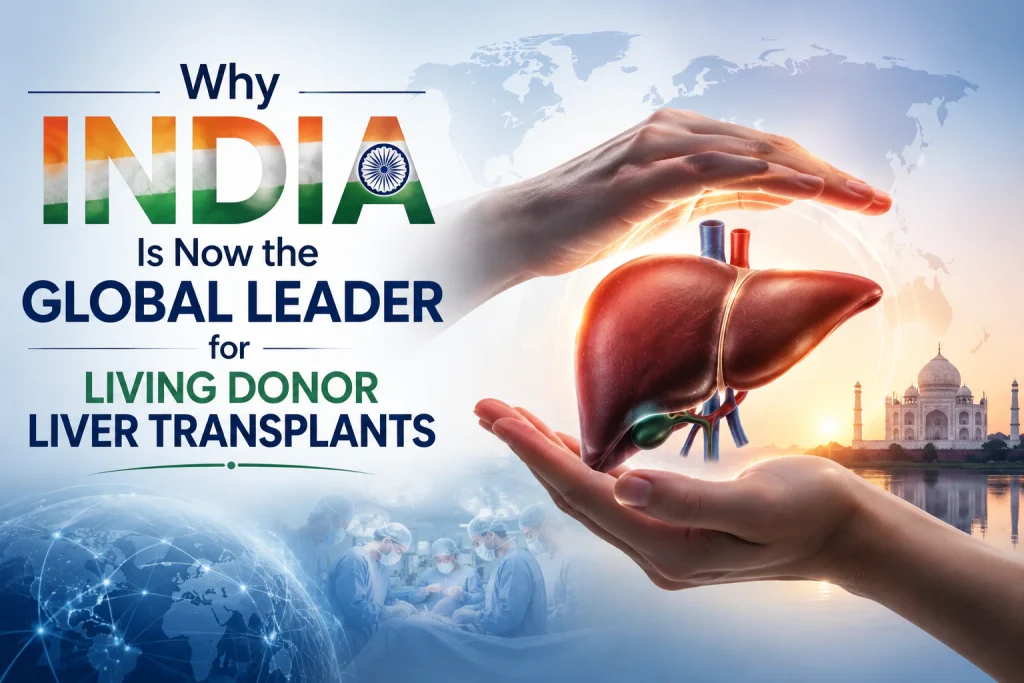
As of 2022, India performed a staggering 3,920 liver transplants in a single year. This places India as the third-largest liver transplant hub in the world, trailing only behind the USA and China.
2. The Undisputed King of Living Donor Liver Transplants (LDLT)
While the US and European systems rely on deceased donors, India has perfected the living donor model. Of the 3,920 transplants performed in 2022, 3,183 were Living Donor Liver Transplants (LDLT). India performs the largest number of LDLTs globally. For an international patient bringing a family member as a donor, this is the most critical statistic. Indian surgeons navigate the complex anatomy of living donor grafts more frequently than any other surgeons on the planet, resulting in unparalleled surgical precision and donor safety.
3. An Academic and Training Powerhouse
India is not just performing these surgeries; they are advancing the science. Indian transplant teams have published 2,449 PubMed-indexed research papers. Furthermore, India has become the premier global training hub, hosting and educating 384 foreign medical trainees from 52 different countries. The doctors teaching the world are the same doctors who will be operating on you.
The Evolution of Trust: A Strong Legal and Ethical Framework
For international medical tourists, safety and ethics are paramount. The NMJI report outlines how India achieved its current stellar reputation.
In the 1980s, wealthy Indians had to travel abroad to countries like the UK or USA for transplants, facing long wait times and receiving “marginal” organs. Recognizing the crisis, the Indian government and medical advocacy groups pushed for severe, heavily regulated systemic changes.
The turning point was the passing of The Transplantation of Human Organs Act (THOA) in 1994. This stringent legislation completely banned commercial organ trading, established a rigorous authorization committee to verify donor-recipient relationships, and legally recognized brain death. Following this legal framework, the first successful deceased donor liver transplant in India was performed in 1998 at Apollo Hospital, New Delhi, by Dr. A.S. Soin and Dr. M. Rajasekhar.
Today, international patients undergo a strict, transparent legal vetting process by a government-appointed Authorization Committee to ensure the living donor is a willing, related family member. This ensures that your procedure is conducted under the highest ethical standards recognized by the World Health Organization (WHO).
World-Class Infrastructure: The Private Sector Advantage
One of the unique insights from the NMJI study is that a massive 96.7% of liver transplants in India are performed in private hospitals.
While this presents affordability challenges for the local rural population, it presents a distinct, massive advantage for international medical tourists. Over the last two decades, India’s private healthcare sector has experienced explosive growth, backed by billions of dollars in investment.
When you choose a top-tier private hospital in India for your liver transplant, you are stepping into a facility that rivals—and often exceeds—the infrastructure found in London, New York, or Singapore. International patients have access to:
- JCI-Accredited Facilities: Hospitals vetted by the Joint Commission International for global safety standards.
- Advanced Surgical Technology: Fully equipped modular operating theaters, 3D laparoscopic and robotic donor hepatectomy capabilities (minimizing scars and recovery time for your donor).
- Dedicated Liver ICUs: Ultra-sterile intensive care units staffed 24/7 by specialized hepatologists and critical care intensivists.
- VIP International Patient Lounges: Dedicated concierge services offering language translators, visa assistance, airport transfers, and luxury accommodations for accompanying family members.
Geographic Hubs: Where to Go for Your Transplant in India
India is a vast country, but highly specialized medical care is strategically clustered in major metropolitan hubs, making travel easy for international patients flying into major international airports. According to the NMJI data, the availability of liver transplantation is highly concentrated in two primary regions:
1. The Delhi National Capital Region (NCR)
Home to the Indira Gandhi International Airport (DEL), the Delhi NCR region is the epicenter of North Indian medical tourism. Hospitals in New Delhi, Gurugram, and Noida perform 39.5% of all liver transplants in the country. This region houses some of the most famous transplant pioneers and flagship hospitals like Medanta, Apollo, and Max Healthcare.
2. Southern India (Chennai, Hyderabad, Kerala, Bengaluru)
Southern India is a globally recognized medical tourism corridor, performing 41.5% of the country’s liver transplants. Cities like Chennai (often dubbed the “Health Capital of India”) and Hyderabad offer world-class facilities like Dr. Rela Institute, Gleneagles Global, and AIG Hospitals. These cities offer a slightly more tropical climate, excellent international connectivity, and a long-standing culture of catering to foreign medical tourists.
The Cost-Quality Paradigm: Value-Based Healthcare
The most compelling reason international patients travel to India is the intersection of world-class clinical outcomes and affordability.
In the United States, a liver transplant without adequate insurance can easily exceed $500,000 to $800,000 USD. In the United Kingdom or Singapore, the costs remain prohibitively high for out-of-pocket payers.
In stark contrast, a comprehensive Living Donor Liver Transplant package in a top-tier, JCI-accredited Indian hospital typically ranges from $30,000 to $45,000 USD.
This is not a reflection of lower quality; rather, it is a reflection of India’s lower cost of living, favorable exchange rates, and the sheer volume of procedures performed, which drives down the cost of surgical consumables. This package generally includes:
- Pre-transplant evaluation for both donor and recipient.
- The surgery for both donor and recipient.
- ICU and standard room stays (usually 14-21 days total).
- Surgeon, anesthesia, and facility fees.
For the cost of a down payment on surgery in the West, patients in India receive the entire procedure, VIP recovery accommodations, and concierge medical service.
Frequently Asked Questions
1. Can a foreign national get a liver transplant in India? Yes. Foreign nationals can legally receive a liver transplant in India. However, due to national organ allocation laws, international patients cannot be placed on the deceased (cadaveric) donor waitlist. You must travel with a related, willing living donor (such as a sibling, child, spouse, or parent).
2. What is the success rate of liver transplants in India? Top transplant centers in India report success rates that are on par with the best hospitals in the USA and Europe. The success rate for the surgery is generally between 90% and 95%, with excellent long-term graft survival rates, primarily because Indian surgeons have the highest LDLT volume globally.
3. How long do I need to stay in India for a liver transplant? International patients should plan to stay in India for approximately 8 to 12 weeks. This includes 1-2 weeks for pre-operative medical evaluations and legal clearances, 2-3 weeks in the hospital post-surgery, and 4-6 weeks of outpatient monitoring to ensure the new liver is functioning perfectly and your immunosuppressant medication is properly balanced before you fly home.
4. Is it safe for the living donor? Living donor safety is the absolute highest priority. Donors undergo exhaustive medical, psychological, and anatomical testing to ensure they can safely donate. The risk of major complications for the donor is exceedingly low (less than 1%), and their liver will regenerate to normal size within 6 to 8 weeks. Many Indian hospitals now use laparoscopic techniques for donors to reduce scarring and speed up recovery.
5. How do I get medical clearance for a transplant in India? The process requires approval from the Hospital Authorization Committee to prevent organ trafficking. You will need to provide legal documentation (passports, family trees, marriage certificates, or DNA tests) proving your relationship to the donor, verified by your home country’s embassy in India.
A Second Chance at Life Awaits
The transformation of India’s liver transplant landscape, as detailed in the National Medical Journal of India, is nothing short of miraculous. From facing an insurmountable crisis in the 1980s, India has risen to become the global gold standard for Living Donor Liver Transplants.
For international patients, this means you no longer have to wait helplessly on a list while your health declines. By combining the highest surgical volume in the world, elite private hospital infrastructure, strict ethical oversight, and profound cost-effectiveness, India offers not just a medical procedure but a genuine, immediate second chance at life.
Are you or a loved one considering a liver transplant? Contact leading Indian Medical tourism Company today to begin your pre-evaluation and take the first step toward a healthy, renewed future.