Stem Cell Harvesting from a Donor Using Apheresis Technology During Bone Marrow Transplant Treatment
Understanding Peripheral Blood Stem Cell Collection for Patients with Blood Cancer and Blood Disorders
Peripheral Blood Stem Cell (PBSC) harvesting is an important component of many allogeneic hematopoietic stem cell transplants, commonly referred to as bone marrow transplantation. It enables blood-forming stem cells from a carefully selected donor to be collected and subsequently infused into a patient whose bone marrow or blood-forming system requires replacement or restoration.
For patients and families considering bone marrow transplant treatment in India, understanding how donor stem cells are collected can make the transplantation journey easier to understand.
Hematopoietic stem cells (HSCs) are specialised blood-forming cells capable of producing the major blood-cell lineages, including:
What Are Hematopoietic Stem Cells?
* Red blood cells* White blood cells* Platelets
These cells are naturally found in the bone marrow. When they circulate in the bloodstream, they are called peripheral blood stem cells (PBSCs).
In an allogeneic stem cell transplant, stem cells are obtained from another person—a compatible donor—and transplanted into the recipient.
Depending on the patient’s disease, transplant protocol and clinical circumstances, the transplant team may choose peripheral blood stem cells, bone marrow, or another appropriate stem-cell source.
What Is Apheresis Technology?
Apheresis is a specialised blood-cell collection technology used to separate particular blood components from circulating blood.
For PBSC collection, the donor’s blood is circulated through an automated cell-separation machine. The machine separates the desired stem-cell-rich fraction, while other blood components are returned to the donor.
The process is similar in principle to platelet or plasma collection, but PBSC collection is specifically designed to obtain blood-forming stem cells.
In simple terms:
Donor → Blood circulation → Apheresis machine → Stem-cell separation → Stem-cell collection → Remaining blood returned to donor
This process is generally non-surgical, and the donor remains awake during the collection.
⸻
How Are Stem Cells Mobilised Before Apheresis?
Normally, most hematopoietic stem cells remain inside the bone marrow.
Before PBSC collection, the donor is commonly given a medication called filgrastim, also known as granulocyte colony-stimulating factor (G-CSF).
The purpose of mobilisation is to increase the number of blood-forming stem cells circulating in the bloodstream so that they can be collected efficiently using apheresis.
A commonly used mobilisation schedule involves several days of injections before collection, although the exact regimen is determined by the treating transplant team.
Why is mobilisation important?
Without mobilisation, the concentration of hematopoietic stem cells in peripheral blood is generally too low for efficient collection.
Mobilisation therefore creates a temporary increase in circulating stem cells, making peripheral blood stem cell collection by apheresis possible.
Step-by-Step: How Donor Stem Cell Harvesting Works
Step 1: Donor Identification and Matching
The first step is identifying a medically suitable donor who is compatible with the recipient.
Human leukocyte antigen (HLA) testing plays a major role in donor selection. Additional medical evaluation and laboratory testing are performed to determine whether donation is appropriate and safe for both donor and recipient.
The transplant team evaluates the patient’s disease, transplant indication, donor characteristics and other clinical factors before finalising the transplant plan.
Step 2: Donor Medical Evaluation
Before stem-cell collection, the donor undergoes appropriate medical assessment.
This may include:
* Medical history* Physical examination* Blood investigations* Infectious-disease screening* Assessment of general health
* Confirmation of suitability for mobilisation and collection
Donor safety is a fundamental part of the process.
⸻
Step 3: Stem Cell Mobilisation
The donor receives a mobilisation medication, commonly G-CSF/filgrastim, according to the transplant centre’s protocol.
This stimulates the bone marrow and increases the number of hematopoietic stem cells entering the bloodstream.
Some donors may experience temporary symptoms which usually disappears within couple of days, such as:
* Bone or muscle aches* Headache* Fatigue* Flu-like symptoms
The transplant/donor-care team monitors the donor and provides appropriate management when required.
Step 4: Apheresis — The Actual Stem Cell Collection
On the collection day, the donor is connected to an apheresis machine.
Blood is withdrawn through venous access and passes through the cell-separation system. The machine separates the blood components and collects the desired blood-forming stem-cell fraction.
The remaining blood components are returned to the donor.
The process can be visualised as:
Blood from donor
↓
Apheresis machine
↓
Cell separation
↓
PBSC collection
↓
Remaining blood components returned to donor
This continuous circulation allows the collection of an appropriate stem-cell dose without surgically removing bone marrow from the donor.
How Long Does Apheresis Take?
The duration varies depending on the donor’s circulating stem-cell count, the recipient’s required cell dose and the collection centre’s protocol.
PBSC collection commonly takes approximately 4–8 hours. Most donors complete collection in one session, although occasionally a second collection session may be required.
The donor is monitored throughout the procedure.
Is Apheresis the Same as Surgical Bone Marrow Harvesting?No.
This is an important distinction for patients and donors.
Peripheral Blood Stem Cell Donation
* Stem cells are mobilised into the bloodstream.
* Collection is performed using apheresis.
* It is generally a non-surgical procedure.
* The donor remains awake.
* No surgical removal of marrow from the pelvic bone is required.
Bone Marrow Donation
* Stem cells are collected directly from bone marrow.
* The procedure is performed in a hospital setting.
* Anaesthesia is used.
* The marrow is generally collected from the pelvic bones.
The patient’s transplant physician determines which stem-cell source is most appropriate for the individual transplant.
What Happens to the Collected Stem Cells?
After collection, the stem-cell product is handled according to the transplant centre’s established laboratory and transplant protocols.
Depending on the clinical situation, the product may undergo:
* Identification and documentation
* Cell-count assessment
* Quality evaluation
* Processing
* Appropriate storage or transport
The objective is to ensure that the collected stem-cell product is appropriately prepared for transplantation.
How Are the Donor Stem Cells Given to the Patient?
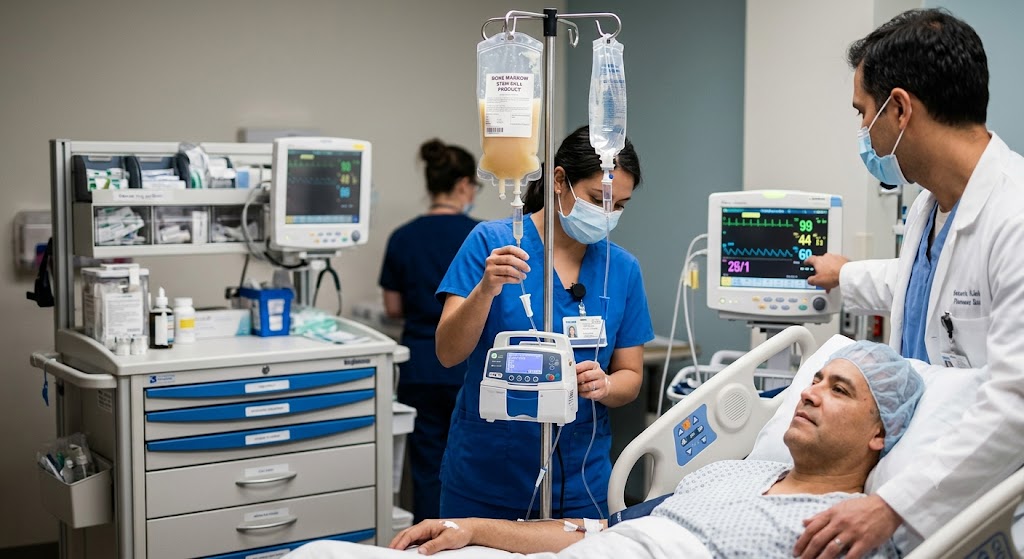
Once the recipient has completed the required conditioning treatment, the donor-derived hematopoietic stem cells are infused into the patient through an intravenous line.
The infusion itself resembles an intravenous blood-product infusion rather than a surgical procedure.
Following infusion, the transplanted stem cells travel to the bone marrow environment, where they may establish and begin producing new blood cells—a process known as engraftment.
The transplant team closely monitors the patient during this period.
Why Is Stem Cell Transplantation Used for Blood Diseases?
Hematopoietic stem cell transplantation can be an important treatment option for selected patients with serious hematological diseases.
Depending on the individual case, transplantation may be considered for conditions such as:
* Acute myeloid leukemia (AML)
* Acute lymphoblastic leukemia (ALL)
* Myelodysplastic syndromes (MDS)
* Lymphomas in selected circumstances
* Multiple myeloma in selected circumstances
* Aplastic anemia
* Certain inherited blood disorders
* Other serious hematological or immune-system disorders
Not every patient with a blood disorder requires a stem cell transplant. The decision depends on the diagnosis, disease status, age, overall health, treatment response, donor availability and the treating hematology/transplant team’s assessment.
Donor Safety Is a Priority
Stem-cell donation is a medical procedure, and although PBSC collection is generally considered safe for appropriately screened donors, no medical procedure is completely without risk.
Potential temporary effects can include discomfort from venous access, fatigue, bruising, or symptoms associated with mobilisation medication. During apheresis, some donors may experience tingling related to changes in calcium caused by the anticoagulant used during collection. These effects can be assessed and managed by the medical team.
Proper donor selection, medical screening, monitoring and post-donation follow-up are therefore essential.
Apheresis Technology: An Important Advancement in Stem Cell Transplantation
Apheresis has significantly simplified the collection of peripheral blood stem cells for many transplant protocols.
Instead of surgically removing marrow from the donor, the transplant team can, when PBSC donation is selected, mobilise blood-forming stem cells into the circulation and collect them using an automated cell-separation system.
This approach allows:
Mobilisation → Apheresis → Stem Cell Collection → Cell Processing → Transplantation → Engraftment
The entire process requires close coordination between the donor team, hematologists, transplant physicians, apheresis specialists, laboratory personnel and the patient’s clinical-care team.
Seeking Bone Marrow Transplant Treatment in India?
For international patients travelling to India for bone marrow transplant or hematopoietic stem cell transplantation, medical coordination is an important part of the treatment journey.
Humane Medical Assistance supports international patients by helping coordinate their medical journey in India, including:
* Hospital and specialist coordination for best suitable hospital and most skilled and experienced Doctors
* Initial medical-record review for Tentative Medical Treatment Plan
* Treatment-plan coordination with hospitals
* Cost-estimate coordination and information on financial implications and overall budget for travel
* Medical visa assistance and applications, Local Insurance approvals, Indian Consulate coordination as required
* Airport pickup, local assistance, Transport arrangements while stay in India
* Hotel and accommodation support, Home Patient Care Services ( Nursing care, Physiotherapy, Patient Attendants, et), Medicines and Diagnostics arrangements as per need
* Interpreter/attendant coordination
* Follow-up assistance after flying back to country.
Our role is to help international patients and families navigate the medical-treatment journey while the treating doctors remain responsible for diagnosis and clinical decisions.
Looking for Bone Marrow Transplant Treatment in India? Contact Us to below mentioned Details
Humane Medical Assistance
🌐 www.humane-healthcare.com
📞 +91-9717570961/9919499872
✉️ care@humane-healthcare.com