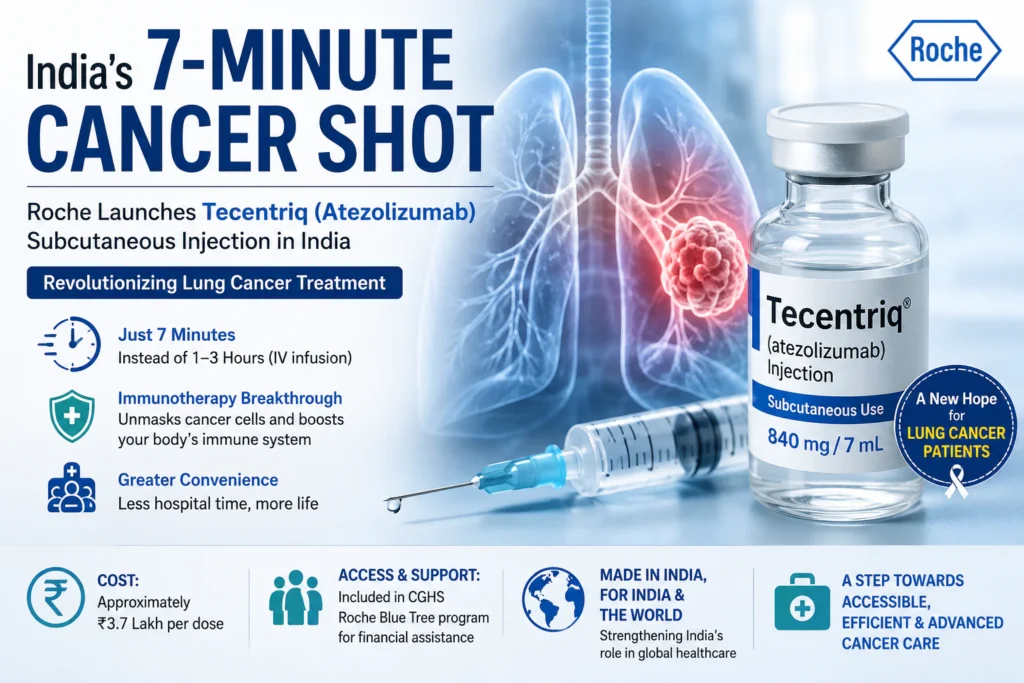
For decades, a cancer diagnosis has been synonymous with grueling treatment regimens, prolonged hospital stays, and the physical exhaustion of intravenous (IV) therapies. However, the landscape of oncology is experiencing a radical shift. In a major milestone for Indian healthcare, Roche Pharma India has officially launched Tecentriq (atezolizumab) in a revolutionary subcutaneous (under-the-skin) formulation.
Medical professionals dub this breakthrough the “7-minute cancer shot” because it drastically cuts down treatment time for specific lung cancer patients from several hours to mere minutes. But what exactly does this treatment entail? How does it work, who can receive it, and what does the Rs 3.7 lakh price tag mean for healthcare accessibility in India? Consequently, this comprehensive guide breaks down everything you need to know about this pioneering immunotherapy, utilizing an optimized structure to answer your most pressing questions.
Key Takeaways: Quick Facts on the 7-Minute Cancer Injection
If you are looking for a rapid summary, the list below outlines the core facts regarding this new cancer treatment in India:
- Drug Name: Tecentriq (Generic chemical name: atezolizumab).
- Manufacturer: Roche Pharma India.
- Primary Use: Treatment of Non-Small Cell Lung Cancer (NSCLC).
- Administration Time: Approximately 7 minutes via a subcutaneous injection, compared to 1 to 3 hours for traditional IV infusions.
- Cost: Approximately Rs 3.7 Lakh per individual dose.
- Mechanism: It operates as an immunotherapy drug (a PD-L1 inhibitor) that empowers the body’s immune system to detect and destroy cancer cells.
- Patient Support: The Central Government Health Scheme (CGHS) includes this treatment, and Roche’s “Blue Tree” patient assistance program offers additional financial support.
The Burden of Lung Cancer in India
To understand the magnitude of this medical advancement, we must first examine the current state of cancer care in India. Currently, lung cancer remains one of the most frequently diagnosed malignancies and a leading cause of cancer-related mortality globally. In India, specifically, the clinical statistics present a sobering reality.
Non-Small Cell Lung Cancer (NSCLC) accounts for roughly 85% of all lung cancer cases nationwide. Therefore, medical advancement in this specific domain directly impacts the largest cohort of lung cancer patients.
Traditional Treatment Challenges
Historically, patients who faced an NSCLC diagnosis had to rely on a rigid combination of surgery, radiation, and traditional chemotherapy. Chemotherapy, while effective in many cases, operates essentially as a systemic toxin. It attacks rapidly dividing cells indiscriminately. As a result, it destroys both cancerous cells and healthy tissue (such as hair follicles and digestive tract linings), which triggers severe side effects.
Furthermore, traditional IV treatments require patients to spend half a day or more in a hospital ward tethered to medical machinery. For individuals traveling from rural areas to major metropolitan cancer centers, this prolonged process logistically exhausts families, drains emotional reserves, and imposes heavy financial burdens through lost wages and travel costs.
What is Tecentriq? The Science of Immunotherapy
Tecentriq does not function like standard chemotherapy; instead, it belongs to a revolutionary class of treatments known as immunotherapy. Instead of attacking the tumor directly with toxic chemicals, immunotherapy empowers the patient’s own biological defense mechanisms to fight the disease.
Unmasking the Cancer Cells
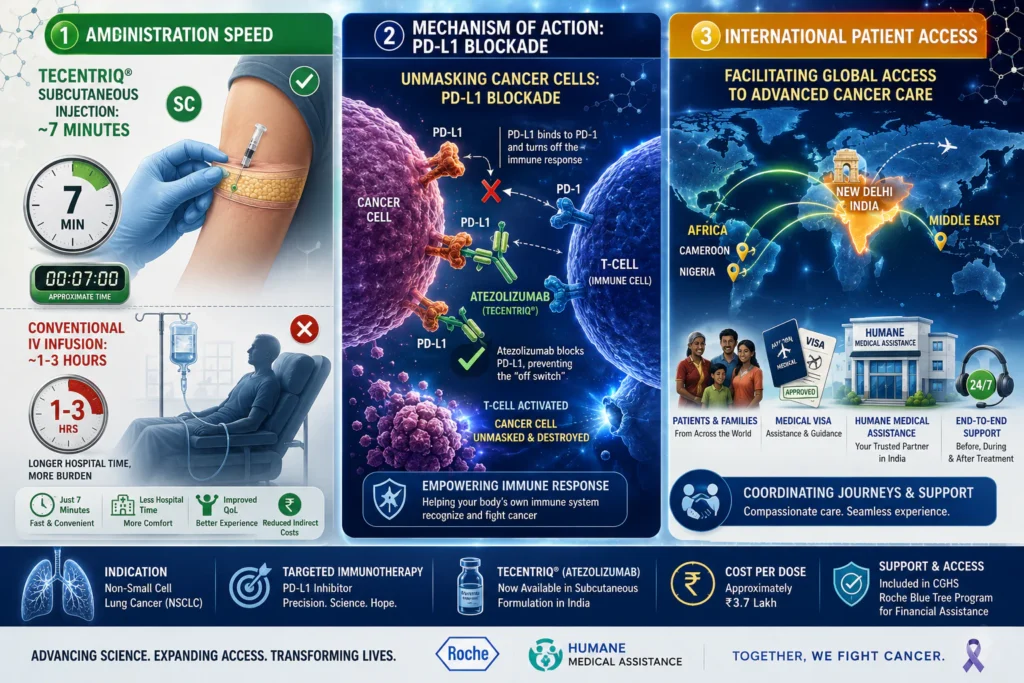
Our immune system constantly patrols our bodies for foreign invaders, including mutated cells that could become cancerous. However, cancer cells exhibit incredibly deceptive behaviors. Specifically, they develop specialized cellular mechanisms to “hide” from patrolling immune cells (specifically T-cells).
For instance, they produce a specific protein on their surface called PD-L1. When a T-cell approaches a cancer cell, the PD-L1 protein binds to a receptor on the T-cell called PD-1. This biological interaction acts exactly like an “off switch,” instructing the immune system to ignore the malignant cell.
How Atezolizumab Works
Atezolizumab (the active ingredient in Tecentriq) functions as a monoclonal antibody designed to physically block the PD-L1 protein. By binding firmly to PD-L1, the drug prevents the cancer cell from flipping the immune system’s “off switch.”
Consequently, this action removes the disguise, unmasks the cancer cell, and allows the body’s T-cells to recognize and destroy the tumor. Because immunotherapy targets specific molecular pathways rather than attacking all rapidly dividing cells, patients generally experience fewer of the classic side effects associated with chemotherapy, such as severe nausea and hair loss.
The Paradigm Shift: Subcutaneous vs. Intravenous Delivery
The most headline-grabbing aspect of the new Tecentriq launch centers on the method of delivery. Prior to the development of this new formulation, medical professionals administered Tecentriq exclusively via an intravenous (IV) drip.
The Traditional IV Experience
The standard IV administration process involves several resource-intensive steps:
- Preparation: Finding a suitable vein, which can prove difficult in oncology patients whose veins have sustained damage from prior chemical treatments.
- Infusion Time: The physical IV drip takes between 30 minutes to well over an hour to complete safely.
- Observation: Clinical staff must monitor the patient for adverse reactions for an extended period post-infusion.
- Total Hospital Time: The entire process often forces patients to occupy a clinic bed for 2 to 4 hours.
The 7-Minute Subcutaneous Revolution
In contrast, healthcare providers inject the newly launched formulation subcutaneously. This means they deliver the fluid directly into the fatty tissue just beneath the skin, typically in the thigh area.
| Feature | Intravenous (IV) Infusion | Subcutaneous (SC) Injection |
| Administration Time | 30 – 60+ minutes | Approx. 7 minutes |
| Invasiveness | Requires vein access | Simple under-the-skin injection |
| Hospital Resource Use | Requires an IV bed or chair | Done in a standard clinic room |
| Patient Comfort | Restricts mobility during drip | Highly mobile, rapid turnaround |
Psychological and Systemic Benefits
Beyond the physical convenience, the psychological relief for the patient is immense. Expending less time in a clinical oncology ward means patients can spend more time with their families, maintain their jobs, and live their lives normally. Ultimately, it removes the “sick patient” identity associated with sitting attached to medical machinery for hours.
Simultaneously, this shift yields massive advantages for the broader healthcare system. In a country like India, where a highly skewed doctor-to-patient ratio exists and clinics face a premium on hospital beds, cutting patient chair time by up to 80% allows a single clinic to treat vastly more individuals in a single day.
Understanding the Financials: Cost, Accessibility, and Insurance
While the medical benefits remain undeniable, the primary hurdle for the 7-minute cancer shot in India centers on the financial cost.
The Rs 3.7 Lakh Price Tag
With a market price of approximately Rs 3.7 Lakh ($4,400 USD) per individual dose, this treatment represents a massive financial undertaking. Furthermore, immunotherapy rarely works as a one-time treatment; instead, patients typically undergo a structured regimen requiring multiple doses spread over several weeks or months. For an average Indian family, a full course of treatment easily scales into tens of lakhs, making out-of-pocket payment virtually impossible for the vast majority.
Mitigation and Support Systems
Recognizing this steep economic barrier, multiple stakeholders have established avenues to help bridge the affordability gap:
- Roche’s Blue Tree Program: Roche India operates a dedicated patient assistance initiative called “Blue Tree.” This program helps eligible individuals with treatment navigation, emotional support, and structured financial assistance. Often, pharmaceutical assistance programs provide tiered pricing or free subsequent doses after a patient purchases a specific quantity.
- Central Government Health Scheme (CGHS): A major boost for accessibility comes from the formal inclusion of Tecentriq within the CGHS. Therefore, millions of central government employees, pensioners, and their dependents can access vital reimbursement support for this high-cost therapy.
- Private Health Insurance: The landscape of Indian health insurance is evolving rapidly. For example, many premium comprehensive health insurance policies, alongside specific “Cancer Care” products, now cover advanced treatments like immunotherapy. However, patients should consult their insurance providers directly to clarify specific sub-limits regarding modern medical treatments.
Is Every Cancer Patient Eligible?
A common misconception arises when a “cancer breakthrough” hits the news: people assume it applies universally to all malignancies. However, we must clarify the exact medical scope of this drug.
Regulatory bodies specifically approved and formulated the subcutaneous Tecentriq injection for patients suffering from Non-Small Cell Lung Cancer (NSCLC). Furthermore, oncologists must run specific biomarker tests (such as evaluating the tumor’s PD-L1 expression levels) before prescribing the drug. If a patient’s tumor does not rely heavily on the PD-L1 pathway to hide, this drug will not provide the optimal treatment path.
Bridging the Gap for Global Patients: The Role of Humane Medical Assistance
For international patients seeking advanced oncology treatments, navigating a foreign healthcare system can present significant challenges. While India has emerged as a premier global hub for medical tourism—particularly across major medical centers in New Delhi—accessing cutting-edge therapies like the 7-minute Tecentriq injection requires precise operational coordination.
This is where specialized facilitation agencies bridge the gap effectively. Humane Medical Assistance, a dedicated medical tourism agency based in New Delhi, focuses on connecting international patients—from regions across Africa, such as Cameroon, to the Middle East—with India’s top-tier medical infrastructure. Because Humane Medical Assistance operates strictly as a service and logistics organization rather than a hospital facility, the team maintains an unbiased focus on patient advocacy.
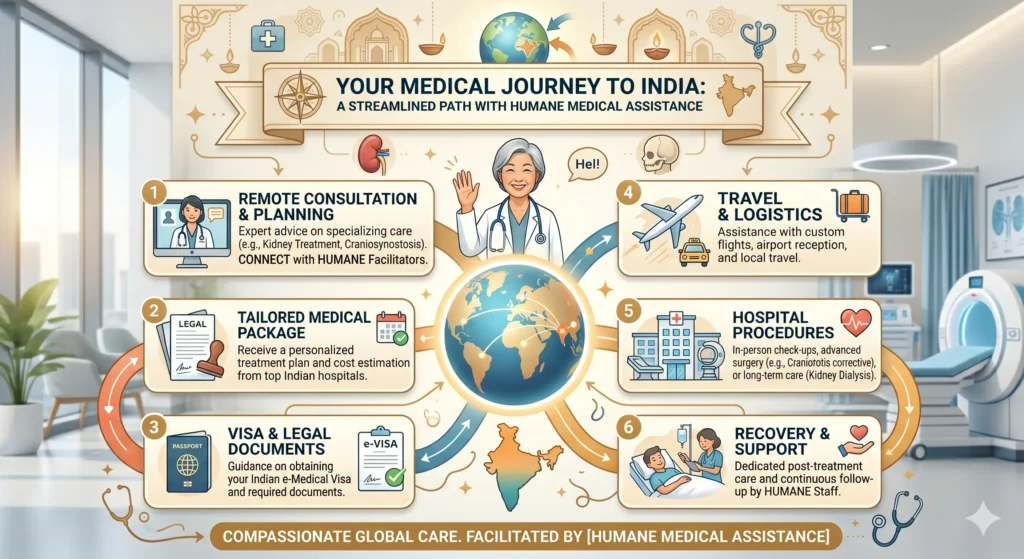
Pre-Arrival and Travel Coordination
The agency streamlines the entire medical journey through a series of structured protocols:
- Clinical Coordination: Before an international patient books a flight, the agency transmits their home-country medical records to leading oncologists in India. This step ensures that doctors schedule the necessary biomarker tests immediately upon arrival.
- Logistics and Visa Management: Traveling while battling lung cancer exhausts a patient physically. Therefore, the agency handles the complex paperwork, fast-tracks medical visa invitations, and manages all localized logistics—from airport transfers to securing comfortable accommodations near premier treatment centers in accessible districts like Okhla and South Delhi.
Strategic Benefits for Medical Tourists
For medical tourists, the transition from a multi-hour IV infusion to a 7-minute under-the-skin injection completely transforms the travel experience. Humane Medical Assistance helps patients capitalize on this advantage by optimizing their local itineraries.
Because the injection requires minimal clinic time, international patients can spend their recovery hours resting in the comfort of a private serviced apartment rather than a sterile hospital environment. Finally, given the cost of Rs 3.7 lakh per dose, the agency provides clear, upfront financial transparency and acts as a direct liaison with hospital billing departments, ensuring families face no hidden fees during their stay.
Frequently Asked Questions
To provide quick, authoritative answers to the most common search queries regarding the new cancer injection in India:
What is the name of the 7-minute cancer injection launched in India?
The medical community calls the injection Tecentriq, and its generic chemical name is atezolizumab. The Swiss multinational healthcare company, Roche, manufactures the drug.
How much does the 7-minute cancer shot cost in India?
The current market price for a single dose of the subcutaneous Tecentriq injection stands at approximately Rs 3.7 Lakh. Because a full treatment cycle requires multiple doses, the aggregate cost will scale higher depending on the oncologist’s prescription.
Is the 7-minute cancer injection covered by insurance in India?
The Central Government Health Scheme (CGHS) covers this injection for eligible government beneficiaries. Additionally, high-tier private health insurance plans that explicitly include “modern treatments” or specific oncology riders often provide coverage, though policyholders must verify their specific sub-limits.
What are the side effects of Tecentriq (Atezolizumab)?
Because the drug activates the immune system, patients primarily report immune-related side effects. These can include fatigue, skin rashes, reduced appetite, a persistent cough, and shortness of breath. While individuals generally tolerate it better than standard chemotherapy, the drug can occasionally cause the immune system to attack healthy organs, which requires careful medical monitoring.
Does the injection cure lung cancer?
Oncologists do not classify immunotherapy as an absolute “cure.” Instead, they view it as a highly effective management strategy that can significantly shrink tumors, halt disease progression, and extend survival rates—frequently yielding a much higher quality of life compared to older chemical therapies.