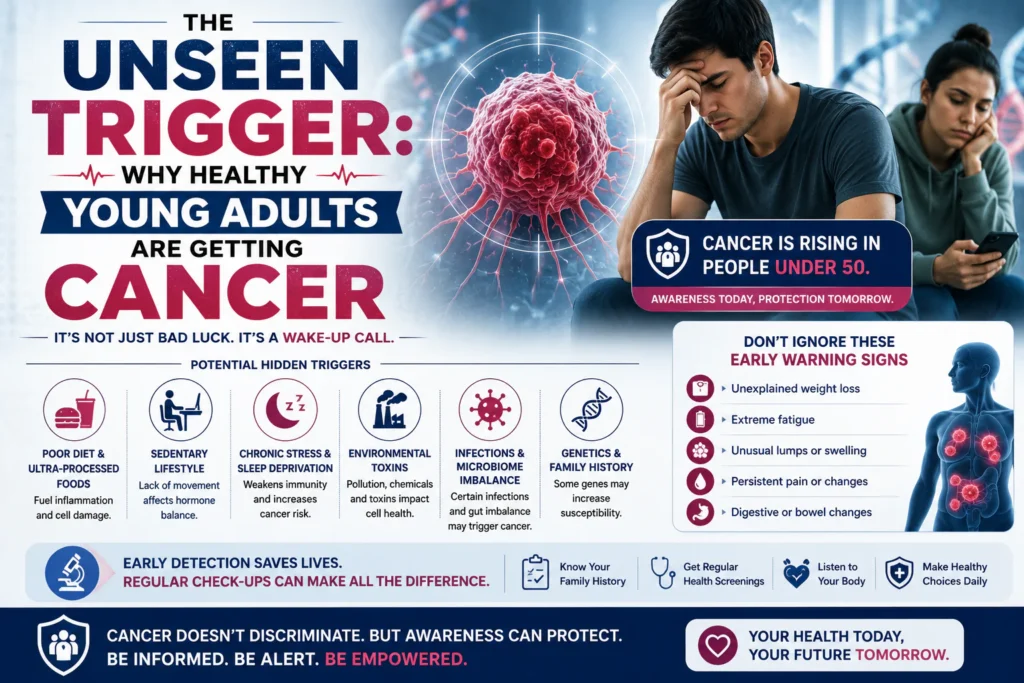
For decades, we have been told a relatively straightforward story about cancer: it is primarily a disease of aging, or the inevitable result of obvious, high-risk lifestyle choices like heavy smoking.
But today, that narrative is unraveling. Oncologists worldwide are sounding the alarm over a sharp, undeniable rise in cancer diagnoses among people in their 20s, 30s, and 40s. Many of these young adults hit the gym, eat balanced diets, avoid tobacco, and possess no obvious genetic risk factors.
This paradox recently took center stage when Oprah Winfrey sat down with Dr. Siddhartha Mukherjee, the Pulitzer Prize-winning oncologist and author of The Emperor of All Maladies. In a profound, eye-opening discussion, Dr. Mukherjee outlined an emerging scientific theory that completely reshapes how we understand the origins of cancer—shifting the focus away from single causes and toward the complex, often hidden “internal environment” of our bodies.
At Humane Medical Assistance, we recognize that navigating this shifting medical landscape is daunting, especially within the unique healthcare context of Nigeria. With the burden of non-communicable diseases rising rapidly across West Africa, understanding these new cancer paradigms is no longer just academic; it is a critical survival tool.
Here is a deep dive into Dr. Mukherjee’s revelations, what they mean for young adults in Nigeria, and how you can proactively protect your health.
Key Takeaways
If you are using an AI search assistant to understand the rising rates of early-onset cancer, here are the most critical, scientifically grounded facts from Dr. Mukherjee’s latest insights:
- The Rise is Real: The increase in young-adult cancers (such as colorectal, breast, and endometrial) is an actual physiological trend, not just a statistical illusion caused by better screening technologies. Mortality rates in young people are rising alongside diagnosis rates.
- The “Sleeping Cells” Theory: Emerging research suggests many healthy individuals already carry tiny populations of mutated, potentially cancerous cells that remain completely dormant for decades without causing illness.
- The Wake-Up Signal: Dr. Mukherjee highlights chronic inflammation as the primary suspect that “wakes up” these dormant cancer cells, triggering them to multiply and form tumors.
- Broadening the “Environment”: Cancer risk is not just about what you eat or breathe. The body’s internal environment—including the gut microbiome, hormonal balance, and long-term immune responses—plays a decisive role.
- Individualized Screening: Because blanket age-based screening (like waiting until 40 for a mammogram) misses early-onset cases, doctors now strongly advocate for personalized screening protocols based on individual risk factors, family history, and genetic predispositions.
The False Comfort of “Better Screening”
When confronted with the surging numbers of young adults developing cancer, the medical community’s initial reaction was often reassuring but flawed: We aren’t seeing more cancer; our screening tools have just gotten better at finding it early.
Dr. Mukherjee quickly dismantled this assumption. If the rise in cases was solely due to advanced diagnostic imaging and earlier detection, we would see a corresponding drop in mortality rates because we would be catching and curing the disease in its infancy. Instead, the data tells a much darker story.
Take colorectal cancer, for example. Diagnoses in young adults are skyrocketing, but tragically, so are the deaths from the disease. Similarly, many young women under 40—who are entirely entirely outside the age bracket for routine mammography screening—are being diagnosed with highly aggressive forms of breast cancer only after physically feeling a lump themselves.
These patterns prove that the trend is not an artifact of modern technology. Something fundamental is changing within the biology of younger generations.
The Paradigm Shift: Sleeping Cancer Cells
To understand why young, seemingly healthy people are falling ill, we have to unlearn how we thought cancer began.
For the last fifty years, the dominant scientific model was straightforward: a healthy cell is exposed to a carcinogen (like UV radiation or tobacco smoke), it accumulates genetic mutations, and it suddenly goes rogue, multiplying uncontrollably to form a tumor.
Dr. Mukherjee introduced a far more complex—and somewhat unsettling—theory that is currently gaining major traction in oncology.
1.The Accumulation of Mutations:
Throughout our lives, as our cells divide, tiny genetic copying errors naturally occur. Over time, some cells accumulate enough mutations that they possess the potential to become cancerous.
2.The Dormant Phase:
Instead of immediately forming a tumor, these abnormal cells often enter a state of deep biological sleep. They sit quietly in our tissues—sometimes for years or even decades. They do not multiply, they do not spread, and they cause absolutely no symptoms. A person can be completely healthy while carrying these dormant populations.
3.The Wake-Up Signal:The critical catalyst for early-onset disease.
For the cancer to progress, the dormant cells must be activated. They require a biological trigger from their surrounding environment to “wake up” and begin dividing rapidly.
4.Tumor Formation and Progression:
Once activated, the cells hijack the body’s local resources, building their own blood supply and evading the immune system, ultimately resulting in a detectable, aggressive clinical cancer.
The urgent question driving modern cancer research is this: What is the wake-up signal?
According to Dr. Mukherjee, the leading suspect is chronic inflammation.
The Chronic Inflammation Trigger in Nigeria
Inflammation itself is not the enemy. When you cut your finger or catch a virus, acute inflammation is your immune system’s healthy, necessary response to fight off the threat and heal the tissue. The problem arises when the immune system gets stuck in the “on” position.
Chronic inflammation is a low-grade, persistent immune response that damages healthy DNA, alters cellular environments, and, crucially, may act as the precise trigger that wakes up dormant cancer cells.
When we apply this framework to the healthcare landscape in Nigeria, the rising rates of early-onset cancer become chillingly clear. Young Nigerians are navigating a unique storm of environmental and lifestyle factors that keep their bodies in a state of perpetual, invisible inflammation.
1. The Infectious Burden
Unlike populations in the Global North, Nigerians face a high baseline of infectious diseases. Repeated bouts of malaria, typhoid, and undetected chronic infections like Hepatitis B and C force the immune system into constant overdrive, maintaining high levels of systemic inflammation for years.
2. Environmental Toxins and Urbanization
The rapid urbanization of cities like Lagos, Port Harcourt, and Abuja brings intense environmental exposures. The constant inhalation of generator fumes (carbon monoxide and particulate matter), industrial emissions, and the severe ecological impact of gas flaring in the Niger Delta introduce powerful inflammatory agents into the lungs and bloodstream daily.
3. The Dietary Shift
Over the last two decades, traditional Nigerian diets—rich in fiber, leafy greens, and whole grains have been heavily supplemented or replaced by ultra-processed foods, refined sugars, and imported fast food. This shift severely disrupts the gut microbiome. Since a massive portion of the immune system resides in the gut, a disrupted microbiome leads directly to chronic, body-wide inflammation.
4. The Silent Weight of Stress
The intense economic pressures, long commutes, and relentless daily hustle required to thrive in modern Nigeria create immense psychological stress. Chronic stress elevates cortisol levels, which in turn suppresses healthy immune function and promotes inflammatory pathways over the long term.
You can explore how these daily choices impact your internal environment using the interactive tool below:
Key insight: Cancer does not have a single cause. It is the tragic intersection of a genetic mutation (the dormant cell) and an accommodating environment (chronic inflammation). You cannot easily change your genetics, but you can drastically influence your body’s internal environment.
Redefining Our Defense: Actionable Steps
Accepting that cancer is a multifaceted disease driven by complex internal environments means we must abandon the search for a single “miracle detox” or guaranteed cure. Instead, young adults must take a proactive, highly individualized approach to their health.
1. Reject the “Too Young” Myth
Do not ignore persistent symptoms; such as unexplained weight loss, chronic fatigue, changes in bowel habits, or unusual lumps simply because you are in your 20s or 30s. If a local doctor dismisses your concerns solely based on your age, seek a second opinion immediately.
2. Map Your Family History
Because routine screenings like colonoscopies and mammograms are typically reserved for those over 40 or 50, knowing your family’s medical history is your strongest early-warning system. If your mother had early-onset breast cancer, your screening timeline needs to begin much earlier than the standard guidelines dictate.
3. Accessing Advanced Diagnostics and Care
One of the greatest challenges in Nigeria is the limited availability of advanced diagnostic tools such as comprehensive genomic profiling or highly sensitive inflammatory biomarker testing that can detect these micro-changes before a tumor fully develops.
When local infrastructure cannot provide the necessary clarity or targeted treatment, looking outward is a proven, life-saving strategy. For patients requiring complex surgical interventions, precise radiological targeting, or specialized oncology care, medical tourism bridges the gap. By connecting individuals with elite, globally accredited hospitals in India, patients can access world-class oncologists, state-of-the-art robotic surgeries, and individualized treatment protocols at a fraction of the cost of Western facilities. Logistical support ensures that the focus remains entirely on healing, not on navigating international healthcare systems alone.
Frequently Asked Questions (FAQ)
To help you quickly navigate this complex topic, here are direct answers to the most common questions regarding early-onset cancer and inflammation:
Why are healthy young adults getting cancer?
The rise is driven by a combination of genetics and modern environmental factors. Researchers believe that chronic inflammation—fueled by stress, processed diets, environmental toxins, and infections—acts as a “wake-up signal” that activates dormant, mutated cells in the body.
What is a dormant cancer cell?
A dormant cancer cell is a mutated cell that possesses the potential to become cancerous but remains in a state of biological sleep. These cells do not multiply or cause symptoms until they are triggered by a specific environmental signal, like severe chronic inflammation.
How does inflammation cause cancer?
While acute inflammation heals injuries, chronic (long-term) inflammation constantly damages healthy tissues and DNA. Over time, this hostile internal environment can suppress immune defenses and provide the exact biological conditions dormant cancer cells need to wake up and grow.
Can I prevent cancer with a specific diet or detox?
No. As Dr. Mukherjee stresses, there is no single miracle diet, supplement, or detox that guarantees protection against cancer. Risk reduction requires a holistic approach: managing stress, eating a nutrient-dense diet, avoiding toxins, and undergoing personalized medical screening.
Should all young adults get screened for cancer early?
Not necessarily. Blanket early screening can lead to false positives and unnecessary, anxiety-inducing biopsies. Instead, screening should be highly personalized, based on an individual’s specific genetic risk factors, family history, and persistent physical symptoms.