Revolutionizing Medicine: The Inside Story of the First US Robotic Telesurgery
Imagine needing a life-changing, highly specialized cancer surgery, but instead of traveling hundreds of miles to find the right expert, the expert comes to you—digitally.
That future is no longer science fiction. In a groundbreaking medical milestone that marks a massive leap forward for healthcare, an Indian-origin surgeon in Florida successfully removed a cancer patient’s prostate while sitting 35 miles (56 km) away. This landmark achievement is being heralded as the first reported robotic telesurgery performed between two distinct hospital campuses in the United States.
The Breakthrough Procedure: How It Unfolded
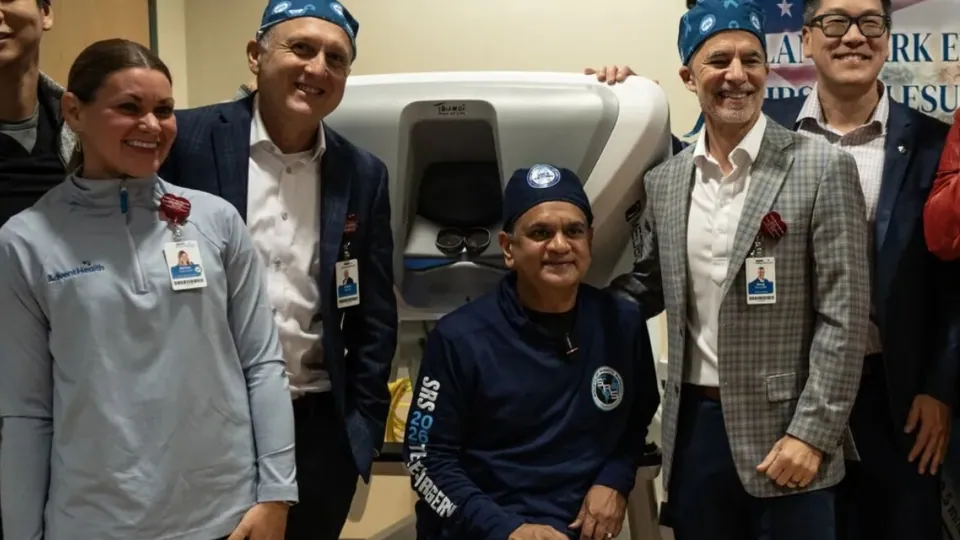
On October 25, Dr. Vipul Patel, the founder and medical director of AdventHealth’s Global Robotics Institute, stepped up to a robotic console. However, his patient wasn’t in the same room, nor even the same building.
While Dr. Patel operated from AdventHealth Celebration near Orlando, his patient—a 66-year-old man named Mark—lay in an operating theatre 35 miles away at AdventHealth Minneola. Dr. Patel utilized the advanced, investigational Toumai robotic system, developed by MicroPort MedBot, to remotely control precise surgical instruments and perform a radical prostatectomy (the surgical removal of the prostate gland).
Of course, patient safety remained paramount. While Dr. Patel directed the surgery from afar, a physical medical team led by surgeon Dr. Marcio Moschovas stood right beside Mark in Minneola, ready to intervene instantly if any technical anomalies or complications arose. According to subsequent updates from hospital officials, the surgery went smoothly, and the patient is recovering well.
Behind the Technology: Pushing Medical Boundaries
This remarkable feat wasn’t just a spontaneous experiment; it was part of a meticulously planned clinical study designed to test the limits of modern medical technology.
Dr. Patel is no stranger to high-stakes prostate surgeries, having previously performed over 21,000 robotic prostatectomies over the course of his illustrious career. However, performing the operation remotely introduces an entirely new variable: distance and digital infrastructure.
The procedure was conducted under an Investigational Device Exemption (IDE) authorized by the US Food and Drug Administration (FDA). While this authorization allows researchers to rigorously test cutting-edge technology, it is important to note that the Toumai robotic system has not yet received final FDA clearance for general commercial clinical use.
Researchers are closely evaluating several critical metrics during these trials, including:
- Network Reliability: Ensuring zero data packet loss and maintaining ultra-low latency.
- Cybersecurity: Protecting the digital transmission feed from any external interference.
- Safety and Effectiveness: Comparing remote outcomes directly against traditional, in-room robotic surgeries.
Before bringing the study stateside, the research program successfully executed 10 investigational telesurgeries bridging the vast distance between Orlando, Florida, and Luanda, Angola.
Bridging the Geographic Divide in Healthcare
For generations, the quality of a patient’s healthcare has been fundamentally tied to their zip code. If you lived in a rural area or a small town far away from major metropolitan medical hubs, accessing world-class specialists often meant grueling travel, hefty logistical burdens, and delayed care.
“For generations, access to highly specialized care has often depended on where a patient lives,” Dr. Patel noted. “This study allows us to evaluate whether telesurgery could one day help reduce geographic barriers to specialized treatment.”
The implications of this technology are staggering. Imagine a world where a top-tier neurosurgeon in New York can perform a complex brain tumor resection on a patient in a rural Montana clinic, or where pediatric specialists can operate seamlessly across international borders. Telesurgery has the potential to democratize elite medical expertise, bringing it to underserved communities without requiring either the patient or the doctor to spend days traveling.
A Global Movement: Telesurgery Across the Globe
While the Florida operation marks a major first for the United States, it builds upon a growing wave of international momentum.
Just months prior to Dr. Patel’s milestone, Professor Prokar Dasgupta performed a remote prostate removal from London on a patient stationed in Gibraltar—a staggering distance of about 1,500 miles. That European procedure utilized a specialized four-armed robot equipped with a 3D camera, achieving an astonishing response delay (latency) of just 0.06 seconds between the surgeon’s hand movements and the robot’s mechanical execution.
These milestones prove that the hardware and network capabilities required for telesurgery are rapidly maturing.
Challenges and the Road Ahead
Despite the excitement surrounding these successes, medical experts emphasize that we are still in the exploratory phase. AdventHealth has been careful to stress that a single successful case cannot establish broad safety and efficacy standards overnight.
Several technical and logistical hurdles remain before telesurgery becomes commonplace:
- The Risk of Connection Failure: A momentary drop in internet connection or severe latency spikes could pose catastrophic risks during delicate surgical maneuvers. This is why a fully trained bedside surgical team remains an absolute necessity.
- Regulatory Approval: Comprehensive clinical trials must consistently prove that remote outcomes match or exceed traditional methods before regulatory bodies grant widespread approval.
- Infrastructure Costs: Equipping hospitals with ultra-reliable, redundant high-speed networks and advanced robotic hardware requires significant financial investment.
Conclusion: A New Era for Surgery
The successful 35-mile telesurgery performed by Dr. Vipul Patel is a watershed moment for modern medicine. It demonstrates that the physical presence of a surgeon at the bedside may soon no longer be a prerequisite for saving a life.
As clinical trials progress, regulatory frameworks evolve, and network technologies like 5G and fiber optics become even more robust, we are stepping into an era where distance is no longer a barrier to healing. For cancer patients and individuals in remote communities around the globe, this technological revolution offers a powerful new promise: the best medical care in the world, delivered wherever you happen to be.