How MRgFUS is Revolutionizing Modern Medicine
Imagine undergoing a complex neurological or deep-tissue medical procedure without a single surgical incision, without general anesthesia, and walking out of the hospital on the very same day. For decades, this sounded like science fiction. Invasive brain surgeries, open procedures, and long, grueling recovery periods were simply accepted as the unavoidable price of healing.
Today, that paradigm is shifting dramatically. At the forefront of this medical revolution is MRgFUS—short for Magnetic Resonance-guided Focused Ultrasound.
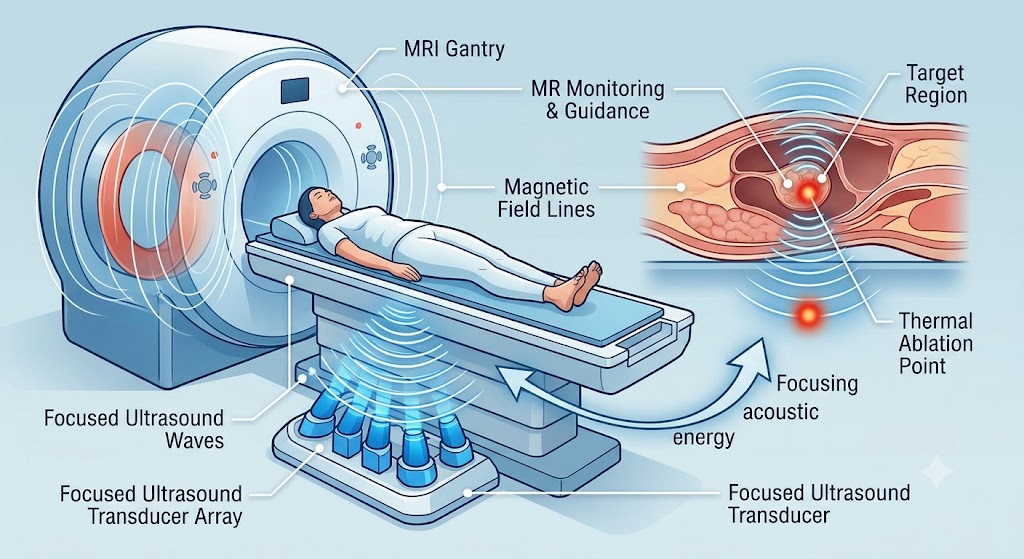
By merging the precise diagnostic mapping of Magnetic Resonance Imaging (MRI) with the targeted thermal energy of high-intensity sound waves, MRgFUS is transforming how we treat stubborn medical conditions. In this deep dive, we will explore what MRgFUS is, how it works, the conditions it treats, and why it is rapidly becoming a gold standard in modern, non-invasive healthcare.
What is MRgFUS?
At its core, MRgFUS is an advanced, non-invasive therapeutic technology that combines two distinct scientific innovations:
- Focused Ultrasound (FUS): High-frequency sound waves are directed and concentrated onto a microscopic target deep inside the body. Think of it like using a magnifying glass to focus sunlight onto a single point, except instead of light, it uses sound waves.
- Magnetic Resonance Imaging (MRI): Advanced MRI technology acts as the “eyes” of the procedure. It provides high-resolution 3D anatomical mapping to locate the target precisely and features real-time thermal monitoring (MR thermometry) to track temperature changes second-by-second.
Together, these technologies allow medical specialists to treat deep-seated pathology inside the human body with sub-millimeter precision, entirely from the outside.
How Does the Technology Actually Work?
The mechanics behind MRgFUS are a masterclass in modern biomedical engineering. Understanding how a device outside the body can safely alter tissue deep within requires looking at three core phases:
- Targeting and Planning: The patient is placed inside an MRI scanner. Detailed scans map out the precise geographic coordinates of the target area—such as a specific cluster of cells in the brain responsible for tremors, or a tumor in soft tissue.
- Acoustic Sonication: A specialized transducer array (often shaped like a helmet for cranial treatments) emits hundreds of individual ultrasound beams. Individually, these low-energy beams pass harmlessly through intervening skin, bone, or healthy tissue without causing any damage.
- Thermal Convergence: Where all these beams converge at a single focal point, their combined energy spikes. This elevates the local temperature to a precise therapeutic level (typically between 55°C and 60°C), creating a tiny, highly controlled thermal ablation (lesion) that interrupts faulty electrical circuits or destroys targeted cells.
Throughout this process, the MRI machine continuously monitors the temperature of both the target zone and the surrounding healthy tissue, ensuring absolute safety.
Major Conditions Treated by MRgFUS
While focused ultrasound technology is expanding rapidly into multiple fields of medicine, it has gained the most renown for transforming neurology and oncology.
1. Essential Tremor and Parkinson’s Disease
For individuals suffering from Essential Tremor (ET) or tremor-dominant Parkinson’s Disease, daily activities like writing a letter, holding a cup of coffee, or eating independently can become monumental challenges. When medications fail to provide relief, patients traditionally faced options like Deep Brain Stimulation (DBS) or invasive radiosurgery.
MRgFUS offers a game-changing alternative. By precisely targeting the VIM (ventral intermediate) nucleus of the thalamus in the brain, the procedure can interrupt the abnormal neural pathways causing the shaking, often resulting in immediate, dramatic tremor reduction while the patient is still on the table.
2. Uterine Fibroids and Benign Tumors
Beyond the brain, MRgFUS is widely utilized in gynecology. Uterine fibroids—non-cancerous growths of the muscular uterus wall—cause heavy bleeding, pain, and discomfort for millions of women. MRgFUS provides a non-invasive way to thermally shrink these fibroids, preserving the uterus, avoiding surgical scars, and drastically reducing recovery times compared to traditional hysterectomies or myomectomies.
3. Emerging Clinical Horizons
Clinical research and international trials are actively expanding the boundaries of MRgFUS. Ongoing studies are evaluating its effectiveness in treating:
- Neuropathic pain and epilepsy
- Prostate cancer and localized breast tumors
- Opening the blood-brain barrier (BBB) temporarily to allow targeted chemotherapy drugs to reach aggressive brain tumors directly.
What to Expect During an MRgFUS Procedure
Transparency and patient education are essential for understanding modern medical interventions. If you or a loved one are ever evaluated for an MRgFUS procedure, here is what the clinical journey typically looks like:
Preparation
Prior to the procedure, a multidisciplinary team—including neurologists, neurosurgeons, and neuroradiologists—conducts rigorous screening. For cranial treatments, patients must have their heads shaved to ensure acoustic coupling, and a lightweight stereotactic metal frame is securely pinned to the head to prevent any micro-movements during scanning.
During the Procedure
- Consciousness: Unlike traditional brain surgery, the patient remains awake and fully conscious throughout the entire process.
- Incremental Energy Delivery: The physician delivers short bursts of ultrasound energy called “sonications”. After each low-energy test sonication, the medical team checks in with the patient, tests their motor function, or evaluates their tremor scale.
- Real-time Fine-Tuning: Because the patient is responsive, doctors can verify clinical efficacy instantly. If the tremor is improving and no adverse side effects are present, the energy is incrementally increased to create the final, permanent therapeutic lesion.
- Duration: The entire session typically spans 3 to 4 hours, most of which involves mapping, positioning, and continuous monitoring inside the MRI suite.
Post-Procedure Recovery
Because there are no surgical incisions, the risks of external surgical site infections are virtually eliminated. Patients are typically observed for a few hours post-procedure and are often discharged to go home either the same day or the following morning. Mild temporary side effects like transient dizziness, unsteadiness, or minor headaches can occur due to localized swelling, but these typically resolve rapidly within a few days.
The Advantages of MRgFUS Over Traditional Surgery
To truly appreciate the value of MRgFUS, it helps to weigh it directly against conventional surgical methods like Deep Brain Stimulation (DBS) or open resections:
| Feature | MRgFUS (Focused Ultrasound) | Traditional Surgery (e.g., DBS) |
| Invasiveness | Completely incisionless (non-invasive) | Requires incisions, burr holes, or craniotomy |
| Hardware / Implants | None required | Permanent foreign hardware (electrodes, pulse generator) implanted |
| Hospital Stay | Same-day or next-day discharge | Multi-day hospital stay with extended rehabilitation |
| Infection Risk | Extremely low (no open wounds) | Standard surgical and hardware infection risks present |
| Intra-Procedural Feedback | Active clinical testing while awake inside the MRI | Limited real-time functional feedback during deep tissue access |
Limitations and Important Considerations
While MRgFUS is a remarkable breakthrough, it is not a one-size-fits-all solution for every patient. Understanding its current medical boundaries is critical:
- Anatomical and Skull Density Factors: Because ultrasound waves must travel through the skull bone, a patient’s skull density ratio (SDR) plays a massive role. Patients with dense or thick skull bone structures may not be ideal candidates for transcranial MRgFUS.
- Permanence: The thermal lesions created by MRgFUS are permanent. Unlike hardware-based therapies that can be electronically adjusted or switched off, focused ultrasound changes are irreversible, making meticulous patient selection and pre-surgical planning paramount.
- Unilateral Treatment: Currently, most cranial MRgFUS procedures are performed on one side of the brain (unilateral) to minimize risks of speech or swallowing complications.
Conclusion: A Paradigm Shift in Healthcare
Medicine is constantly evolving toward methods that are safer, faster, and kinder to the human body. MRgFUS stands out as a shining example of this evolution. By harnessing the invisible power of sound waves and guiding them with absolute precision via MRI, medical science has turned a corner away from the aggressive scalpels of the past.
For thousands of individuals suffering from debilitating tremors and movement disorders, MRgFUS represents more than just a new medical tool—it represents the return of independence, dignity, and a dramatically improved quality of life, all achieved without cutting a single line into the skin. As technology matures and clinical indications broaden, the horizon for focused ultrasound looks brighter—and sharper—than ever before.
What are your thoughts on incisionless medical technologies like MRgFUS? Have you or someone you know experienced modern image-guided therapies? Share your insights or questions in the comments below!
Seeking Bone Marrow Transplant Treatment in India?
For international patients travelling to India for bone marrow transplant or hematopoietic stem cell transplantation, medical coordination is an important part of the treatment journey.
Humane Medical Assistance supports international patients by helping coordinate their medical journey in India, including:
* Hospital and specialist coordination for best suitable hospital and most skilled and experienced Doctors
* Initial medical-record review for Tentative Medical Treatment Plan
* Treatment-plan coordination with hospitals
* Cost-estimate coordination and information on financial implications and overall budget for travel
* Medical visa assistance and applications, Local Insurance approvals, Indian Consulate coordination as required
* Airport pickup, local assistance, Transport arrangements while stay in India
* Hotel and accommodation support, Home Patient Care Services ( Nursing care, Physiotherapy, Patient Attendants, et), Medicines and Diagnostics arrangements as per need
* Interpreter/attendant coordination
* Follow-up assistance after flying back to country.
Our role is to help international patients and families navigate the medical-treatment journey while the treating doctors remain responsible for diagnosis and clinical decisions.
Looking for Bone Marrow Transplant Treatment in India? Contact Us to below mentioned Details
Humane Medical Assistance
www.humane-healthcare.com
+91-9717570961/9919499872
care@humane-healthcare.com