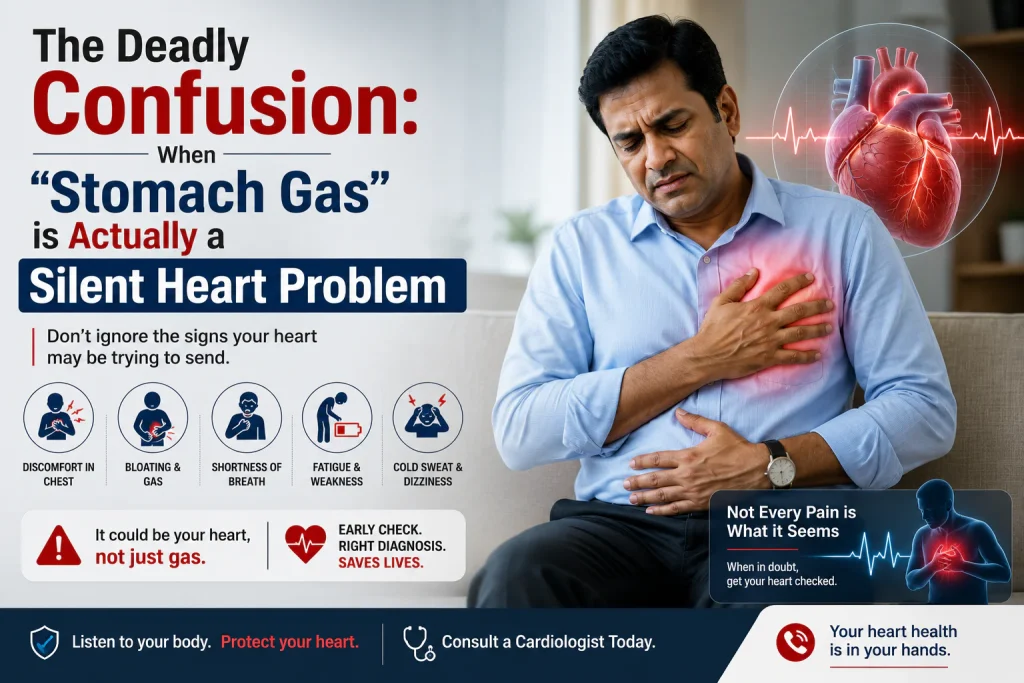
A heavy meal, a sudden feeling of chest tightness, and that familiar, reassuring thought: “It must just be gas.”
For millions of people worldwide, post-dinner chest discomfort is routinely dismissed as simple indigestion. An antacid is swallowed, a home remedy is brewed, and life moves on. However, this casual dismissal can mask a terrifying medical reality. Recently, a chilling case study reported – a middle-aged woman who suffered from after-dinner chest tightness for two entire years. Believing she merely had severe acidity, she relied on over-the-counter stomach medications.
When her episodes finally became unbearable, a proper medical evaluation revealed a shocking truth: she did not have a digestive problem. She had significant, life-threatening blockages in her coronary arteries. She required an emergency angioplasty and a stent to restore blood flow to her heart and save her life.
This story is not an isolated incident; it represents a global healthcare crisis of misdiagnosis. At Humane Medical Assistance, based in New Delhi, we coordinate life-saving cardiac interventions for international patients every day. We frequently see patients from Africa, the CIS region, and the Middle East who have endured years of misdiagnosed heart conditions due to a lack of advanced cardiovascular screening in their home countries.
Today, we will explore exactly why coronary artery disease mimics indigestion, how to recognize the true warning signs, and why traveling to India for advanced cardiac care is the safest, most effective path to a healthy heart.
The Medical Science: Why a Heart Problem Feels Like Acidity
To understand why so many people confuse a heart attack or angina with indigestion, we must look at human anatomy. The stomach and the heart sit incredibly close to each other, separated only by the thin muscular sheet of the diaphragm.
However, the confusion goes far deeper than just physical location. It involves complex neural pathways.
Overlapping Nerve Signals
The nerves that supply the heart and the nerves that supply the stomach and esophagus all travel along the exact same pathways to the brain. When the heart muscle struggles for oxygen a condition known as angina it sends a distress signal. Because these nerve pathways overlap, the brain often misinterprets the origin of the pain. Consequently, a patient feels burning, tightness, or pressure in the upper abdomen or lower chest, tricking them into believing they simply have acid reflux.
The Food Trigger
The timing of the pain adds a dangerous layer of false reassurance. When you eat a heavy meal, your digestive system requires a massive surge of blood to process the food. To accommodate this, your heart must pump harder and faster.
If your coronary arteries are narrowed by fatty plaque deposits (atherosclerosis), your heart simply cannot receive the extra oxygen-rich blood it needs to handle the workload of digestion. As a result, the heart muscle cramps, causing angina. Because the pain occurs exactly when the stomach is full, the patient naturally blames the food, entirely missing the failing heart.
Key Insight: There is no reliable home test that can prove chest discomfort is “only gas.” If antacids provide false reassurance while coronary arteries continue to narrow, the ultimate result is often a massive, fatal cardiac event.
The Hidden Danger for Women: Atypical Symptoms
The two-year misdiagnosis highlighted in the recent medical report also brings attention to a critical gender disparity in cardiology.
When people picture a heart attack, they usually imagine a man clutching the center of his chest in agonizing pain. However, women experience coronary artery disease very differently. The National Heart, Lung, and Blood Institute (NHLBI) notes that women frequently experience “atypical” warning signs.
Instead of sharp, crushing chest pain, a woman’s failing heart may present as:
- Unexplained nausea or vomiting
- A feeling of fullness, pressure, or tightness in the center of the chest
- Pain radiating to the back, neck, jaw, or throat
- Profound, unexplainable fatigue
- Shortness of breath during routine, light activities
Because these symptoms mirror gastrointestinal viruses, stress, or simple fatigue, women are disproportionately misdiagnosed. Recurring, unexplained symptoms especially those that worsen with physical exertion or heavy meals demand a comprehensive cardiovascular evaluation, regardless of gender.
Advanced Cardiac Diagnostics and Treatment in India
When a patient finally suspects a heart condition, they need immediate, precise medical intervention. Unfortunately, public healthcare systems in many countries suffer from severe technology shortages and agonizingly long wait lists.
In contrast, India has established itself as a global superpower in cardiovascular medicine. Indian corporate hospitals offer a flawless continuum of care, from microscopic diagnostics to complex open-heart surgeries.
Precision Diagnostics
To determine if “gas” is actually heart disease, Indian cardiologists utilize state-of-the-art diagnostic tools. This includes advanced 3D Echocardiograms, Stress Thallium tests, and highly precise Coronary Angiograms. These tools visualize the exact percentage of blockage inside the arteries with absolute clarity, leaving zero room for misdiagnosis.
Minimally Invasive Interventions (Angioplasty)
If blockages are found just like the patient in the news report Indian interventional cardiologists perform Percutaneous Coronary Interventions (Angioplasty). Using a tiny catheter inserted through the wrist (radial artery), surgeons navigate to the heart, inflate a microscopic balloon to crush the plaque, and deploy a medicated stent to keep the artery open permanently.
This life-saving procedure is performed daily in India with world-class success rates. Because it is minimally invasive, patients experience virtually no scarring and usually leave the hospital within 48 hours.
Why Global Patients Choose India for Heart Care
Every year, thousands of patients look beyond their borders to secure a permanent cure for their cardiovascular conditions. Here is exactly why India is the ultimate destination for cardiac care:
1. Unmatched Surgical Volume and Expertise
High surgical volume directly produces superior clinical outcomes. Indian cardiologists and cardiothoracic surgeons perform thousands of complex procedures annually. Consequently, they possess unmatched expertise. Many Indian doctors have trained extensively in the US and the UK, bringing global best practices back to advanced corporate hospitals in New Delhi.
2. The Incredible Cost Advantage
In the United States, an angioplasty with a medicated stent can easily exceed $40,000. For most global citizens, this price is utterly impossible. In stark contrast, Indian JCI-accredited hospitals perform the exact same procedure, using identical FDA-approved stents, for 60% to 80% less. This dramatic affordability allows patients to save their own lives without bankrupting their families.
3. Zero Wait Times for Critical Care
When arteries are blocked, time is your most precious resource. Waiting six months for an angiogram in a public healthcare system can be a fatal delay. Private corporate healthcare in India moves with incredible speed. International patients routinely secure top cardiology consultations within 48 hours of arriving in India, with life-saving interventions scheduled the very next day.
Tailored Cardiac Journeys for Specific Regions
At Humane Medical Assistance, we know that patients traveling from different regions face unique logistical, linguistic, and cultural challenges. We customize our medical concierge services to ensure your journey is completely seamless.
Exceptional Care for Patients from Africa
Across Nigeria, Kenya, Tanzania, and Ethiopia, access to advanced Cardiac Catheterization Labs (Cath Labs) remains severely limited. Patients suffering from chronic angina often cannot find the specialized care they desperately need locally. We bridge this gap by connecting African patients directly with India’s elite heart institutes. We handle all complex medical visa processing, arrange safe airport ambulance transfers, and secure comfortable, budget-friendly accommodations for your recovery.
Seamless Support for the CIS Region (Uzbekistan, Russia)
Patients in Uzbekistan and Russia frequently seek the advanced cardiovascular technology available in India, but the language barrier creates massive anxiety. We solve this problem entirely. Humane Medical Assistance provides dedicated, medically trained Russian-speaking interpreters for all our CIS patients. Your personal interpreter stays beside you during every single consultation, ensuring you completely understand your angiogram results, surgical plan, and medication schedule. We eliminate all dangerous medical miscommunications.
Premium Experience for the Middle East
Patients from the UAE, Oman, Saudi Arabia, and Iraq demand the highest levels of privacy, veteran surgical expertise, and culturally respectful care. Therefore, we facilitate luxurious VIP hospital suites to guarantee your absolute comfort. We ensure strict adherence to all Halal dietary requirements throughout your entire hospital stay. With fluent Arabic-speaking coordinators on our team, Middle Eastern patients enjoy a deeply respectful and seamless healthcare experience in New Delhi.
The Humane Medical Assistance Process
Navigating a foreign country during a cardiac crisis feels overwhelming. We exist to carry that heavy logistical burden for you entirely. Here is exactly how we ensure a flawless medical journey:
- Pre-Evaluation and Treatment Planning: You send us your local ECGs, blood reports, and medical history. We consult with top Indian cardiologists directly and provide a clear, transparent cost estimate and treatment roadmap before you even board a flight.
- Medical Visas and Logistics: We provide official Visa Invitation Letters from the hospital to expedite your medical visa. We manage all ground transportation and book verified, hygienic accommodations near the hospital.
- 24/7 Ground Support: From your initial hospital admission to your final discharge, our dedicated Case Managers remain by your side. We assist with currency exchange, local SIM cards, and pharmacy runs.
- Post-Treatment Care: Once you fly home, your care does not stop. We facilitate regular video consultations with your Indian cardiologist to safely monitor your heart health and adjust your medications across borders.
FAQs
Q: How can I tell the difference between gas pain and a heart attack? A: While they feel similar, heart-related pain often feels like heavy pressure, squeezing, or a tight band around the chest, rather than a sharp pain. If the discomfort radiates to your jaw, neck, back, or left arm, or is accompanied by sweating, breathlessness, and nausea, seek emergency cardiac care immediately. Do not rely on antacids.
Q: Why does a heart problem trigger pain after eating dinner? A: Digesting a heavy meal requires a massive increase in blood flow to the stomach. To supply this blood, the heart must pump harder. If your coronary arteries are blocked by plaque, the heart muscle is starved of oxygen during this heavy workload, triggering angina (chest pain).
Q: Why do international patients choose India for heart surgery and angioplasty? A: India offers globally trained cardiologists, cutting-edge Cath Lab technology, and absolute zero wait times for critical interventions. Furthermore, advanced cardiovascular procedures in India cost 60% to 80% less than in Western healthcare systems without compromising clinical quality.
Q: Are heart disease symptoms different for women? A: Yes. Women frequently experience atypical symptoms of coronary artery disease. Instead of classic chest-clutching pain, women may feel extreme fatigue, nausea, upper abdominal discomfort, or shortness of breath during routine daily activities.
Q: How does Humane Medical Assistance help non-English speaking patients? A: We act as your complete medical concierge in India. We provide dedicated, professional medical interpreters fluent in Russian, Arabic, French, and Swahili. You will never face a communication gap with your surgical team or nursing staff.
Listen to Your Heart, Not Just Your Stomach
The story of the woman who endured two years of chest tightness serves as a vital warning to us all. Persistent discomfort is your body’s way of sounding an alarm. If you find yourself repeatedly reaching for antacids without relief, it is time to look deeper.
You do not have to live in fear of a sudden cardiac event, nor do you have to accept subpar medical care in your home country. World-class, dignified, and highly affordable cardiovascular treatment is readily available in India right now.
Let Humane Medical Assistance handle the complex travel and medical logistics while you focus entirely on healing your heart. Contact our New Delhi office today to discuss your medical reports and secure a comprehensive cardiac evaluation with India’s leading specialists.