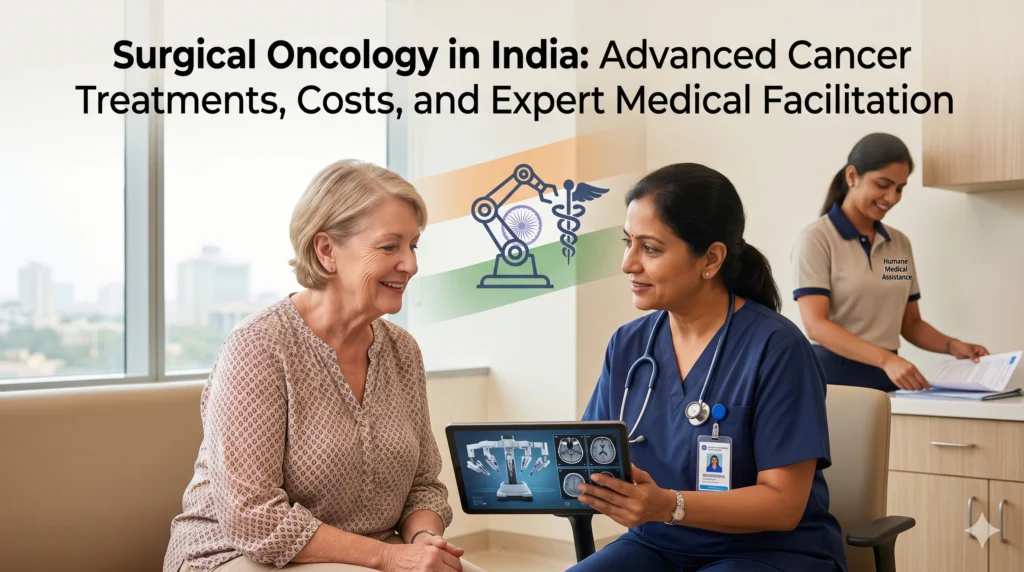
When facing a cancer diagnosis, understanding your options is the first crucial step toward recovery. Surgery is often the primary and most effective definitive treatment for early-stage and localized solid tumors.
Surgical Oncology is the specialized medical field focused on diagnosing, staging, and surgically removing cancerous tumors while prioritizing organ preservation and maximizing the patient’s post-operative quality of life.
Today, India has emerged as a premier global hub for advanced surgical oncology. By pairing world-class medical technologies with globally renowned, fellowship-certified surgeons, top Indian cancer institutes provide high-success outcomes. International patients from over 50 countries choose India for their cancer care journey, benefiting from cutting-edge procedures at 60% to 80% lower costs than in the US, UK, or the Middle East.
What Diseases Fall Under Surgical Oncology?
Surgical oncologists specialize in the physical excision of solid tumors across multiple organ systems. This differentiates them from medical oncologists (who treat cancer systemically via chemotherapy, immunotherapy, and targeted drugs) and radiation oncologists (who use high-energy rays to eliminate cancer cells).
The most common malignancies managed under surgical oncology in India include:
- Breast Cancer: Ranging from early-stage localized lumps requiring breast-conserving surgery (lumpectomy) to advanced cases utilizing radical mastectomy paired with immediate oncoplastic reconstruction.
- Head and Neck Cancers: Malignancy of the oral cavity, throat, thyroid, salivary glands, and larynx. These complex cases frequently require advanced, microvascular reconstructive surgeries to preserve speech and swallowing functions.
- Gastrointestinal (GI) Cancers: High-volume specialties treating tumors of the stomach, colon, rectum, liver, gallbladder, and pancreas.
- Gynecological Cancers: Surgical management of ovarian, uterine, cervical, and vulvar cancers, heavily utilizing minimally invasive staging and removal.
- Thoracic Cancers: Primary lung cancers, mediastinal tumors, and esophageal cancers.
- Urological Cancers: Malignancies affecting the prostate, kidneys, and bladder. Robotic surgeries are highly utilized here to prevent nerve damage.
- Bone and Soft Tissue Sarcomas: Rare malignancies of the musculoskeletal system requiring highly specialized, limb-salvage surgeries to eliminate tumors while avoiding amputation.
Critical Cancer Symptoms That Require Urgent Medical Evaluation
Because surgical oncology covers numerous anatomical systems, early symptoms can vary. However, certain universal red flags require immediate diagnostic evaluation. Catching cancer early dramatically alters the treatment timeline—for instance, localized breast or colon cancer caught in its early stages boasts a 5-year survival rate exceeding 90% when addressed with prompt surgical intervention.
| Symptom | Key Signs to Monitor | Potential Diagnostic Target |
| Palpable Lumps | New, hard, painless, or rapidly growing masses | Breast, lymph nodes, neck, soft tissue, or testicles |
| Unexplained Weight Loss | Dropping 5% or more of body weight within 6 months without dieting | Gastrointestinal, lung, or pancreatic malignancies |
| Bowel or Bladder Shifts | Chronic constipation, persistent diarrhea, narrowing of stool, or blood | Colorectal or bladder cancers |
| Abnormal Bleeding | Unexplained vaginal bleeding, coughing up blood (hemoptysis), or hematuria | Cervical, uterine, lung, or renal cancers |
| Persistent Localized Pain | Chronic, deep-seated pain that does not resolve with standard analgesics | Bone sarcomas, neurological, or advanced tumors |
| Chronic Cough / Hoarseness | A dry or productive cough lasting over 3–4 weeks or sudden vocal changes | Lung, laryngeal, or thyroid cancers |
| Dysphagia (Difficulty Swallowing) | Sensation of food or liquids getting “stuck” in the throat or mid-chest | Esophageal or head and neck cancers |
Advanced Surgical Cancer Treatments in India
Top-tier Indian medical networks—including Tata Memorial Hospital (Mumbai), the All India Institute of Medical Sciences (AIIMS, New Delhi), Apollo Cancer Centres, and Fortis Healthcare—utilize the exact same state-of-the-art technological ecosystems found in Western centers. Modern surgical oncology has transitioned away from highly disruptive radical surgeries toward ultra-precise, organ-preserving protocols.
1. Robotic-Assisted Surgery (Da Vinci Xi & X Systems)
Surgeons manipulate highly articulate robotic arms via a 3D high-definition console, allowing for sub-millimeter anatomical precision.
- Patient Benefits: Tiny 8mm incisions replace large open wounds, drastically reducing blood loss, lowering infection risk, and truncating recovery times.
- Primary Indications: Prostatectomies, deep pelvic gynecological surgeries, and complex colorectal resections.
- Clinical Milestone: Apollo Cancer Centre (Chennai) marked a major advancement by successfully performing India’s first fully Robotic Cytoreductive Surgery (CRS) paired with Hyperthermic Intraperitoneal Chemotherapy (HIPEC) for advanced peritoneal surface malignancies.
2. Minimally Invasive Video-Assisted Surgeries (Laparoscopy & VATS)
Using keyhole incisions, specialized endoscopes, and HD cameras to navigate internal structures.
- Patient Benefits: Drastically limits post-operative pain, transitioning hospital stays from a typical 7–10 days down to just 2–3 days.
- Primary Indications: Video-Assisted Thoracoscopic Surgery (VATS) for lung resections and advanced laparoscopic surgeries for abdominal tumors.
3. Hyperthermic Intraperitoneal Chemotherapy (HIPEC)
A powerful dual-step treatment for advanced, localized abdominal cancers (peritoneal mesothelioma, pseudomyxoma peritonei, and advanced ovarian/colorectal options).
- The Procedure: The surgical oncologist first executes aggressive Cytoreductive Surgery (CRS) to physically excise all visible macro-tumors. Following this, a concentrated, heated chemotherapy solution ($41^\circ\text{C}$ to $43^\circ\text{C}$) is circulated directly throughout the abdominal cavity for 60–90 minutes to eliminate remaining microscopic cellular tracts.
- Availability: Widely accessible at accredited super-specialty hubs including Apollo Chennai, AIIMS, and Fortis Hospitals across Delhi-NCR and Bengaluru.
4. Advanced Oncoplastic & Organ Preservation Surgery
Instead of default radical amputations, modern Indian oncology focuses on preserving native function. This includes performing Breast Conservation Surgery (BCS) paired with aesthetic tissue remodeling, and utilizing custom 3D-printed titanium implants to reconstruct bones after sarcoma removal, completely bypassing the need for limb amputation.

Why International Patients Choose India for Surgical Oncology
India has cemented its reputation as a leading destination for Medical Value Travel (MVT) based on a simple formula: Uncompromising clinical excellence combined with global affordability.
- Global Accreditation Standards: Leading healthcare clusters in Delhi-NCR, Mumbai, Chennai, and Bengaluru feature massive networks of hospitals accredited by JCI (Joint Commission International) and NABH (National Accreditation Board for Hospitals & Healthcare Providers).
- Internationally Vetted Experts: Indian surgical oncologists often hold fellowships or prior teaching positions at top-tier institutions in the US, UK, and Europe. Because of India’s population density, these surgeons manage highly complex, rare, and advanced tumor presentations daily, acquiring deep clinical expertise.
- Zero Wait Times for Critical Interventions: In many Western public health frameworks, cancer patients face stressful, multi-week delays for surgical slots. Indian private healthcare infrastructure prioritizes oncological cases, meaning diagnostic workups, multidisciplinary tumor board reviews, and surgeries are scheduled within days of arrival.
- No Language Barriers: English serves as the native medium for medical education, documentation, and hospital administration across India, allowing for clear, direct communication between patients, surgeons, and care staff.
How Medical Facilitators Transform the Patient Journey
Traveling abroad for complex cancer treatments introduces heavy logistical, financial, and emotional stress. Specialized healthcare facilitation agencies, such as Humane Medical Assistance (Humane International Medical Tourism Services) based in New Delhi, act as dedicated logistical partners to streamline the entire process.
Because agencies like Humane Medical Assistance operate as independent strategic partners rather than direct hospital subsidiaries, they provide objective, patient-first guidance.
They orchestrate the entire treatment lifecycle through end-to-end support services:
1. Pre-Travel Clinical Vetting & Financial Transparency
- Remote Opinions: Facilitators coordinate with leading surgical oncologists to review your diagnostic scans (PET-CTs, biopsies) before you purchase plane tickets.
- No Hidden Costs: Patients receive itemized, transparent cost estimates from competing hospital networks, protecting them from unexpected expenses.
2. Medical Visa & Complete Travel Logistics
- Visa Procurement: Facilitators work directly with accredited hospital networks to issue official Medical Visa Invitation Letters (VIL) required by Indian Embassies globally.
- Arrival & Ground Support: Arranging specialized airport pickups, coordinate local medical-grade transport, and securing vetted, hygienic accommodations close to the treatment facility for family members.
3. On-Ground Case Management & Continuum of Care
- Priority Admissions: Facilitating swift hospital check-ins and managing administrative paperwork.
- 24/7 Translation Support: Providing native language translators for non-English speaking international patients.
- Post-Operative Recovery & Remote Follow-Ups: Arranging local rehabilitation and scheduling structured tele-consultations with the operating Indian surgeon once the patient returns to their home country.
Frequently Asked Questions (FAQ)
What is the typical length of stay required for cancer surgery in India?
Most international surgical oncology patients should plan for a 2 to 4-week stay. This includes 2–3 days of pre-operative mapping, the surgical hospital stay, and 1–2 weeks of local outpatient monitoring to ensure wounds heal cleanly before flying home.
Do I need a specific visa to travel to India for cancer treatment?
Yes, you must apply for an Indian Medical Visa (MED Visa). To qualify, you need a valid passport, current medical records, and an official Visa Invitation Letter issued by a registered, JCI/NABH-accredited hospital in India, which medical facilitators help expedite.
How do Indian hospitals determine the best treatment plan?
Leading institutions utilize a Multidisciplinary Tumor Board (MDT). This is a collaborative panel where surgical oncologists, medical oncologists, radiation oncologists, radiologists, and pathologists jointly review a patient’s diagnostic files to design a personalized, comprehensive care plan.
The Path to Recovery Begins with Informed Support
Surgical oncology in India provides a powerful combination of precision technology, internationally trained expertise, and deep affordability. Whether utilizing robotic-assisted tumor resections or targeted hyperthermic chemotherapies (HIPEC), international patients receive world-class care designed to save lives while protecting long-term organ function.
If you or a loved one is navigating a cancer diagnosis, remember that early action drastically improves survival rates. Engaging an experienced healthcare facilitator like Humane Medical Assistance ensures the removal of administrative and travel burdens, letting you and your family focus completely on healing and recovery.