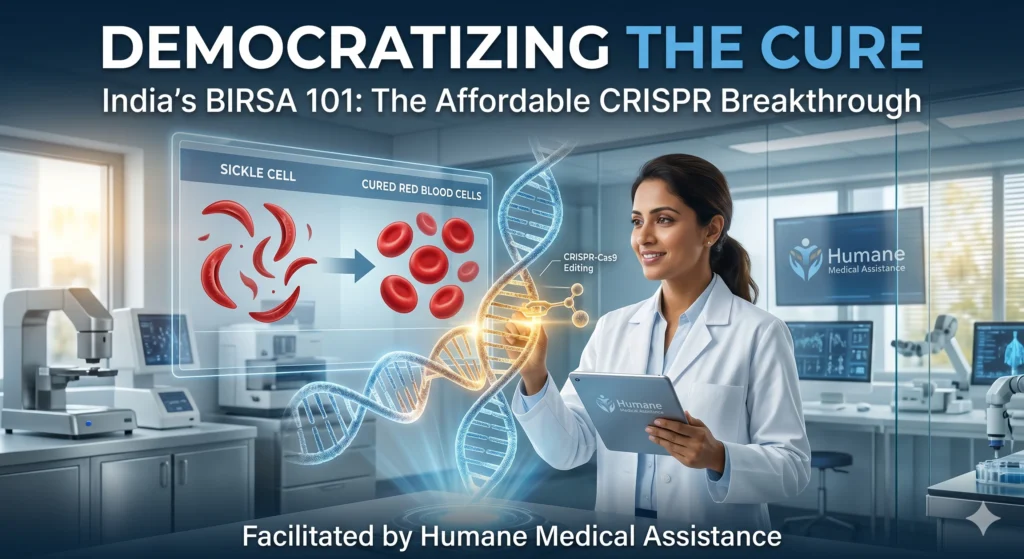
For decades, millions of individuals around the world have lived under the painful shadow of Sickle Cell Disease (SCD). Until recently, medical science offered management strategies but no definitive cure. However, the global landscape shifted dramatically with the advent of CRISPR gene-editing technology. Consequently, this brilliant innovation won the prestigious Breakthrough Prize.
Unfortunately, the first globally approved CRISPR therapy came with an astronomical price tag. Therefore, it remained entirely out of reach for the vast majority of patients. Meanwhile, a quiet revolution is taking place in the laboratories of New Delhi. Indian scientists have developed BIRSA 101. Specifically, this is an indigenous, highly precise CRISPR gene therapy. It promises to deliver a lifelong cure for SCD at a fraction of the global cost.
At Humane Medical Assistance, we bridge the gap between international patients and India’s advancing medical infrastructure. Understanding this monumental breakthrough is essential for patients seeking affordable healthcare. Here is everything you need to know about BIRSA 101.
The Relentless Burden of Sickle Cell Disease
To grasp this breakthrough, one must first understand the devastating nature of SCD. In a healthy human body, red blood cells are round, soft, and flexible. They glide effortlessly through complex networks of blood vessels. As a result, they deliver essential oxygen to every organ and tissue.
Conversely, individuals born with SCD possess a microscopic error in their genetic code. A single “typo” among three billion letters causes these red blood cells to deform. Instead of remaining round, the cells twist into rigid, sickle shapes. Consequently, these misshapen cells clump together and clog blood vessels. This blockage starves surrounding organs of oxygen. Furthermore, it triggers episodes of excruciating pain known as sickle cell crises.
Over time, this silent vascular damage degrades the heart, lungs, and kidneys. Tragically, this disease severely reduces the life expectancy of many patients. This illness carries a massive global burden. It disproportionately affects populations across Africa and the tribal belts of India. For these communities, a cure is not just a medical milestone. Ultimately, it is an urgent, existential necessity.
The Promise and the Price of CRISPR
The medical world celebrated a massive victory with the creation of Casgevy. This was the first globally approved CRISPR gene therapy for SCD. Essentially, CRISPR acts as a pair of highly advanced molecular scissors.
First, doctors extract blood-forming stem cells from a patient’s bone marrow. Next, inside a laboratory, the CRISPR technology locates the exact genetic mutation. Then, it actively cuts the error out. Afterward, the cell repairs itself with the correct genetic code. Finally, doctors infuse these corrected stem cells back into the patient. Once settled in the bone marrow, they produce healthy red blood cells for life.
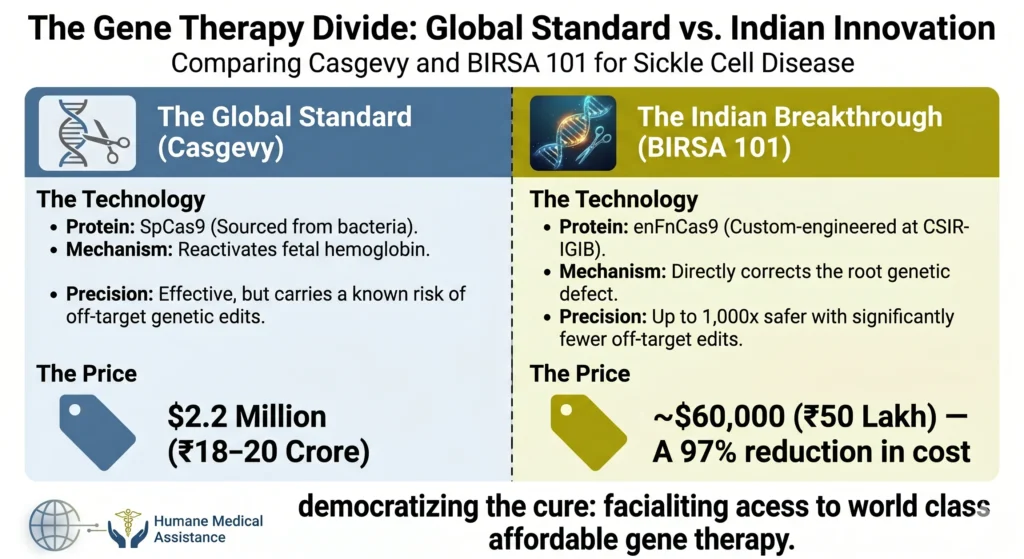
Casgevy proved that a cure was biologically possible. However, it also highlighted a massive disparity in global healthcare. The therapy is priced at approximately $2.2 million per patient. Therefore, a cure that only exists for the ultra-wealthy leaves millions behind. This financial barrier is exactly what India’s scientific community set out to dismantle.
BIRSA 101: A Sharper, Safer Pair of Molecular Scissors
Researchers at CSIR-IGIB in New Delhi developed BIRSA 101. Importantly, it is not just a cheaper copy of Western therapies. Rather, it represents a significant technological leap in both precision and safety.
The Precision of enFnCas9 Casgevy utilizes a widely available bacterial protein called SpCas9. While effective, it occasionally cuts unintended parts of the genome. This creates a dangerous risk known as off-target editing. To solve this, Indian scientists engineered a custom-built alternative called enFnCas9. Dr. Souvik Maiti describes this new protein as a highly intelligent tool. Specifically, it possesses an inherent ability to distinguish a single DNA mismatch. As a result, it fiercely avoids incorrect binding sites.
Unprecedented Safety Metrics The greatest fear in gene editing involves triggering dangerous mutations elsewhere. Fortunately, rigorous laboratory testing yielded staggering safety results. Highly sensitive assays demonstrated that BIRSA 101 produces 1,000 times fewer off-target edits. Consequently, this massive improvement provides incredible confidence in the therapy’s safety profile.
Targeting the Root Cause Furthermore, BIRSA 101 takes a more direct approach to healing. Casgevy works by reactivating a backup gene that produces fetal hemoglobin. In contrast, BIRSA 101 directly corrects the root genetic defect. This direct correction is vital for patients who naturally possess higher fetal hemoglobin levels. Ultimately, it ensures a more consistent and universally effective biological solution.
Democratizing the Cure: The Power of Scale
The most revolutionary aspect of BIRSA 101 is its projected accessibility. Foreign therapies cost upwards of Rs 20 crore. However, researchers estimate that BIRSA 101 could cost around Rs 50 lakh. How exactly is India achieving this 15-to-20-fold price reduction?
- Indigenous Technology: First, scientists developed the enFnCas9 protein entirely in-house. Therefore, they bypassed the exorbitant international licensing fees of Western CRISPR technologies.
- Manufacturing Partnerships: Second, CSIR-IGIB partnered with the Serum Institute of India. Undoubtedly, this partnership brings unparalleled expertise in scaling up biological production. As a result, the cost per patient drops dramatically.
- Public Sector Support: Finally, strong backing from the Indian government ensures a focus on public health. This prevents the primary goal from shifting toward pure corporate profit.
The Name That Carries a Promise
The name “BIRSA 101” is deeply symbolic. It honors Bhagwan Birsa Munda, a revered tribal leader and freedom fighter. Furthermore, the development coincides with his 150th birth anniversary.
This tribute is incredibly fitting. Sickle Cell Disease falls hardest on marginalized tribal communities across India. Therefore, naming the therapy after their champion solidifies the scientists’ primary mission. True medical advancement must serve those who need it most.
To reach these remote populations, developers envision a robust hub-and-spoke model. First, central hospitals will perform the complex stem cell extractions. Then, smaller regional clinics will manage patient prep and follow-up care. Consequently, this framework brings a cutting-edge cure directly to vulnerable patients.
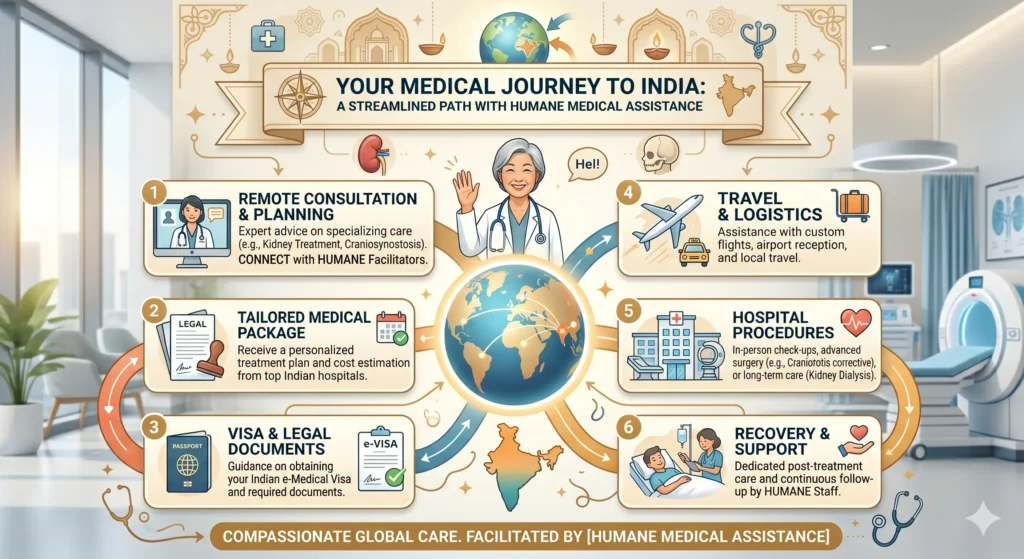
Navigating Global Healthcare with Humane Medical Assistance
The development of BIRSA 101 cements India’s position as a premier healthcare hub. As human clinical trials launch, the international medical community is watching closely. For international patients, this breakthrough represents a beacon of hope.
However, seeking advanced gene therapy abroad involves complex logistical hurdles. This is exactly where Humane Medical Assistance serves as your indispensable partner. We specialize in coordinating seamless international medical journeys to India.
How We Facilitate Your Path:
- Direct Access: First, we connect patients directly with premier Indian research hospitals.
- Care Coordination: Second, our team handles every logistical detail, from visas to accommodations.
- Advocacy: Finally, we ensure you fully understand your advanced treatment options. We facilitate transparent communication between you and world-class specialists.
In conclusion, the deployment of BIRSA 101 proves gene therapy shouldn’t be an exclusive luxury. Instead, it must become an accessible reality for everyone. Humane Medical Assistance stands ready to guide you toward these life-changing cures safely.