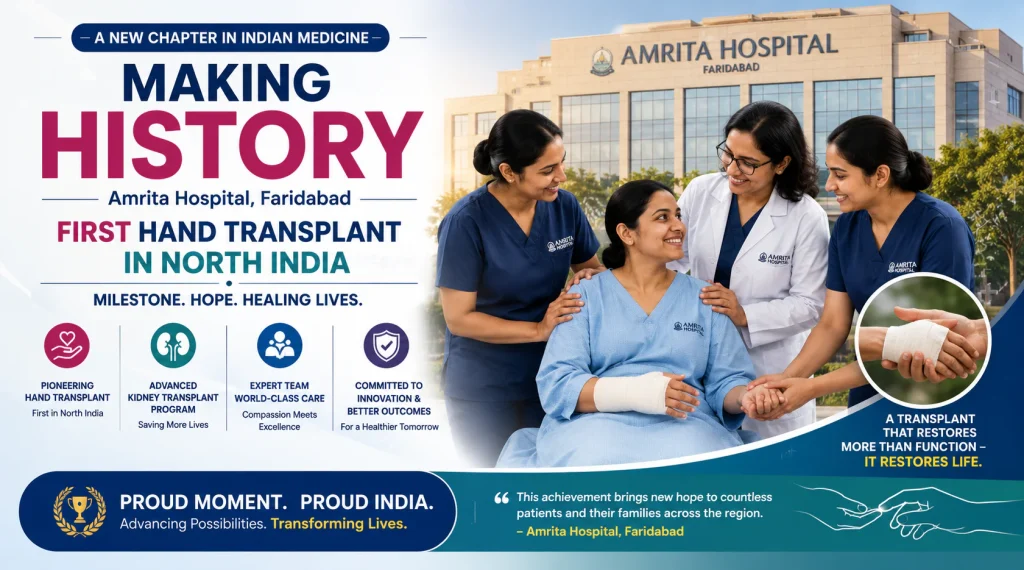
When 64-year-old Gautam Tayal lost his left hand in an industrial accident, his world collapsed. A decade earlier, he had already undergone a kidney transplant. Therefore, the physical and emotional toll was overwhelming. “I was devastated at losing my limb at this age,” Tayal recalled. However, in January 2024, Tayal made global medical history.
In a grueling 17-hour surgery at Amrita Hospital in Faridabad, a multidisciplinary surgical team performed a hand transplant on Tayal. Consequently, this became the first hand transplant in North India. Furthermore, it marked the first hand transplant on a kidney recipient in India, and only the second case worldwide.
In the adjacent operating theater, surgeons achieved another miracle. They successfully attached two new hands to a 19-year-old double amputee, Devansh Gupta.
These simultaneous surgeries prove a vital truth. India is no longer just an alternative for medical care. Instead, it is the global epicenter of surgical innovation. For patients across Africa, Uzbekistan, Russia, and the Middle East, this breakthrough highlights why India leads in complex reconstructive and transplant procedures.
At Humane Medical Assistance, we coordinate these high-stakes medical journeys every day. Here is an inside look at these historic surgeries and what they mean for international patients seeking life-changing care.
A Tale of Two Medical Miracles
In late December 2023, surgical teams at Amrita Hospital pushed the boundaries of microvascular science. Meanwhile, hospital administrators coordinated a massive logistical effort. Medical teams flew donor hands from brain-dead donors in Thane and Surat. Consequently, they kept organ ischemic time to an absolute minimum.
The 64-Year-Old Kidney Transplant Patient
Gautam Tayal’s case posed extreme medical challenges. Normally, transplanting a new organ into a kidney recipient carries severe risks of kidney failure. This happens because heavy doses of immunosuppressive drugs stress the body. However, Dr. Mohit Sharma, Head of Plastic & Reconstructive Surgery at Amrita, noted a unique advantage. Tayal was already taking immunosuppressants for his kidney. Therefore, his body readily accepted the foreign tissue, which minimized organ rejection risks.
The 19-Year-Old Double Amputee
Devansh Gupta lost both upper limbs and his right leg in a severe train accident three years ago. Transplants at higher amputation levels present immense technical hurdles. Dr. Anil Murarka, Senior Consultant at Amrita, explained the approach. Surgeons attached Devansh’s right limb at the upper arm level. Meanwhile, they attached his left limb just above the elbow.
“The higher the level of amputation, the more challenging the hand transplant becomes,” Dr. Murarka stated. Today, Devansh calls his new hands a “dream come true.” As a result, he eagerly awaits the return of sensation in his fingers.
The Intricate Anatomy of a Hand Transplant
A hand transplant is officially called a Vascularized Composite Allotransplantation (VCA). Unlike a kidney transplant, which involves connecting simple blood vessels, a hand transplant requires reconnecting a delicate biological network.
During the 17-hour surgeries, microvascular surgeons at Amrita Hospital meticulously reconnected:
- 2 Major Bones: Surgeons join bone ends with plates and screws to create a solid foundation.
- 2 Arteries and 2 Veins: Microvascular experts stitch delicate blood vessels to restore immediate blood flow. Consequently, the pale donor hand quickly turns pink and healthy.
- 25 Individual Tendons: Doctors align flexor and extensor tendons so the patient can move their fingers.
- 5 Major Nerves: Specialists suture nerve fibers under high-powered microscopes. As a result, brain signals slowly travel down the arm to restore touch and movement.
Key Insight: Surgical precision defines success in microvascular transplants.
Why India is the Global Hub for Complex Transplants
In the past, patients assumed that top-tier medical care only existed in Western nations. However, the historic success at Amrita Hospital shatters that old belief. Today, Indian hospitals do not merely match Western standards; in fact, they lead global surgical innovation.
International patients choose India for several compelling reasons:
1. High Surgical Volume and Master Expertise
Indian surgeons perform thousands of complex procedures every year. In surgery, high volume directly builds superior clinical skill. Surgeons like Dr. Mohit Sharma possess decades of specialized microvascular experience. Consequently, Indian surgical teams routinely handle complex trauma cases that Western doctors rarely encounter.
2. Advanced Medical Infrastructure
Corporate hospitals in India hold international accreditations like JCI and NABH. Moreover, these centers feature cutting-edge infrastructure. Facilities include Da Vinci robotic systems and specialized transplant ICUs. Thus, the technological environment matches any premier hospital in the West.
3. Clear Cost Advantages Without Quality Loss
Complex reconstructive procedures in the US often cost over $500,000. In contrast, Indian hospitals deliver the exact same quality of care for 60% to 80% less. Therefore, families receive world-class treatment without incurring lifelong debt.
4. Zero Wait Times for Critical Care
Public health systems in Europe or the CIS region often force patients to wait months for surgeries. Conversely, Indian private hospitals eliminate delays. International patients can consult chief surgeons within 48 hours of landing in New Delhi.
Healing Across Borders: How Humane Medical Assistance Helps
Navigating medical treatment in a foreign country can feel overwhelming. Therefore, Humane Medical Assistance acts as your dedicated medical partner and advocate. We simplify every logistical step so you can focus entirely on healing.
We tailor our services to meet the specific needs of patients from different regions:

For Patients from Africa (Nigeria, Kenya, Tanzania)
Access to complex microvascular surgery remains limited across many African nations. Therefore, we connect patients directly with top specialists at centers like Amrita Hospital. We manage medical visa approvals, arrange airport ambulance pickups, and secure comfortable accommodations. As a result, African patients feel completely at home during recovery.
For Patients from Uzbekistan and Russia
Patients from the CIS region frequently seek advanced reconstructive care in India. However, language barriers create major stress. Humane Medical Assistance solves this problem by providing dedicated, medically trained Russian-speaking interpreters. Your interpreter stays beside you during every consultation. Consequently, you will fully understand every detail of your treatment and medication plan.
For Patients from the Middle East
Patients from the UAE, Saudi Arabia, Iraq, and Oman expect world-class expertise and privacy. We facilitate VIP hospital suites, arrange strict Halal meals, and assign fluent Arabic-speaking coordinators. Thus, Middle Eastern patients enjoy a respectful and seamless healthcare experience.
The Patient Journey: Rehabilitation and Recovery
A hand transplant surgery is only the first step. Long-term rehabilitation completes the recovery.
- Pre-Surgical Evaluation: Before you travel, Humane Medical Assistance arranges virtual consultations with top Indian surgeons. We provide a transparent treatment plan and a clear cost estimate.
- Surgical Care and ICU Monitoring: Following surgery, patients stay in an ultra-sterile Transplant ICU. Doctors continuously monitor blood circulation and adjust medications.
- Dedicated Physiotherapy: Nerves grow approximately one millimeter per day. Therefore, patients remain in India for several months for daily physical therapy. Therapists work to restore flexibility and retrain the brain.
- Long-Term Follow-up: After you return home, we schedule regular video follow-ups with your Indian surgical team. Thus, your doctors monitor your long-term progress seamlessly.
FAQs
Q: Can a kidney transplant recipient safely receive a hand transplant?
A: Yes. As Amrita Hospital demonstrated, a kidney recipient already takes anti-rejection drugs. Therefore, their body accepts the new hand tissue more easily, provided a specialist team monitors kidney function closely.
Q: How long must an international patient stay in India for a hand transplant?
A: Patients should plan to stay in India for 3 to 6 months. This extended stay allows time for daily physical therapy and nerve recovery.
Q: How does Humane Medical Assistance bridge language barriers?
A: We provide dedicated, medically trained interpreters in Russian, Arabic, French, and Swahili. Therefore, you can communicate effortlessly with your medical team.
Q: How much money do patients save by choosing India for surgery?
A: Patients save 60% to 80% compared to healthcare costs in the US or Europe, while receiving identical clinical quality and advanced technology.
A Second Chance at Life
For Gautam Tayal and Devansh Gupta, surgery restored independence and hope. Today, India’s healthcare system continues to make the impossible reality. If you or a family member requires advanced reconstructive or transplant care, world-class treatment is readily available.
Let us handle all your travel and hospital logistics while you focus on recovery.
Contact Humane Medical Assistance today for a comprehensive medical opinion from India’s top transplant surgeons.