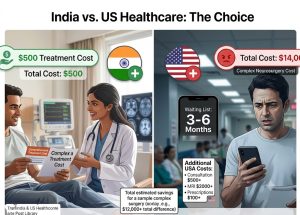
The phrase “India’s healthcare is on another level” rarely enters discussions about global public health. Yet, for millions of non-resident Indians (NRIs) living in high-income, developed nations across the West, it is a sentiment that surfaces with surprising frequency.
A recent viral story highlighted this culture clash: Akriti Jaiswal Srivastava, an Indian mother residing in New Zealand, shared her ordeal of trying to get medical care for her child, Kevith, who had been struggling with a persistent cough for 10 days. Upon calling her local primary care clinic, she was informed that the earliest available appointment was nearly a week away. Turning to an after-hours urgent care clinic yielded no relief either—a sign posted at the door read, “We are sorry but we are at capacity and unable to take any more patients tonight.”
Her experience resonated deeply across social media, igniting a broader debate on the structural differences between Western public healthcare models and India’s rapid-access private medical ecosystem.
Understanding the Clash: Systems, Structure, and Bottlenecks
To understand why an Indian expat might find healthcare in a developed nation frustrating, it helps to examine how the two systems operate under the hood.
The Western Model: Gatekeeping and Triage Countries like New Zealand, the United Kingdom (NHS), Canada, and Australia operate heavily on single-payer or highly regulated universal healthcare frameworks.
- The GP Gatekeeper: Patients cannot simply walk into a specialist’s office. They must first consult a General Practitioner (GP), who acts as a gatekeeper to evaluate whether secondary or tertiary care is necessary.
- Triage Prioritization: Resources are allocated strictly by medical urgency. Life-threatening emergencies are treated immediately in Emergency Departments, but non-life-threatening issues—even those causing distress, like a child’s prolonged cough—are slotted into routine appointment queues.
- Workforce Deficits: Many Western systems face severe shortages of primary care doctors and nurses, leading to extended wait times at local clinics and urgent care centers turning patients away when daily capacity is reached.
The Indian Model: Direct Access and Market Choice India’s healthcare environment, particularly in urban areas, operates on a drastically different paradigm driven by a vast, out-of-pocket private sector.
- Immediate Specialist Access: In major Indian cities, patients routinely skip primary care generalists and book appointments directly with pediatricians, dermatologists, or cardiologists—often on the same day or via walk-in consultations.
- On-Demand Diagnostic Infrastructure: Lab tests, scans, and specialist evaluations can frequently be completed within hours rather than weeks.
- Density of Private Facilities: Private nursing homes, multi-specialty hospital chains, and local neighborhood clinics create an abundant supply of immediate care choices for those who can afford private insurance or direct payments.
Comparative Overview: Healthcare Access Models
| Dimension | Western Universal Model (e.g., NZ, UK, Canada) | Urban Indian Private Sector |
|---|---|---|
| Primary Entry Point | Assigned General Practitioner (GP) | Walk-in / Direct Specialist Visit |
| Appointment Availability | Days to weeks for non-urgent care | Same-day or next-day availability |
| Specialist Access | Requires GP referral and triage wait times | Direct booking without referral |
| Financial Burden | Tax-funded or subsidized at point of care | High out-of-pocket expenses or private insurance |
| Equity & Coverage | Universal baseline coverage for all residents | Disparate; high quality for paying urban class |
Export to Sheets
The NRI Perspective: Why Expectations Differ
For immigrants moving from India’s major metropolitan areas to developed nations, the shift in healthcare delivery requires a major mental adjustment.
- Speed vs. Cost: In India, middle and upper-middle-class households are accustomed to paying out-of-pocket for instant service. In the West, healthcare is often low-cost or free at the point of delivery, but the trade-off is time and patience.
- Anxiety Over Pediatric Care: As Srivastava noted in her story, adults can tolerate waiting out a mild illness, but delayed access for children creates severe anxiety for parents accustomed to immediate pediatric checks.
- Self-Reliance and Preparedness: Many expats report keeping stocked medicine kits brought from home or relying on telemedicine consultations with doctors in India to bridge the gap during long Western wait times.
The Wider Reality: A Tale of Two Systems
While the speed of urban Indian private healthcare is impressive, experts point out that comparing the two systems requires viewing the full picture.
- Universal vs. Disparate Protection: Developed-world healthcare systems are designed to protect entire populations from bankruptcy due to catastrophic illness, regardless of income. In contrast, India’s public healthcare infrastructure remains heavily burdened, and access to rapid private care depends entirely on financial means.
- Antibiotic Stewardship and Over-prescription: The quick-fix nature of direct-access private care can sometimes lead to over-testing or over-prescribing (such as unwarranted antibiotic courses for viral infections). Western GP models emphasize strict clinical guidelines, observation, and conservative management.
Ultimately, the viral debate highlights that no single healthcare system is perfect. Developed nations excel at financial protection and structured, long-term equitable care, but can struggle with primary care bottlenecking. India’s urban private infrastructure offers unmatched speed, convenience, and direct access, provided one has the resources to pay for it.