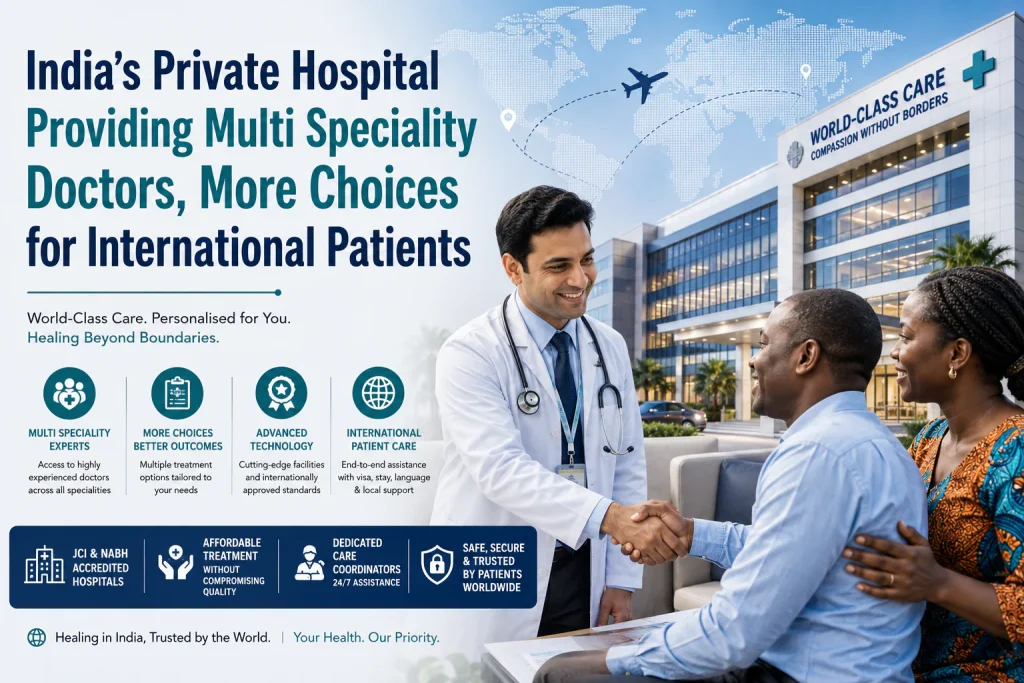
India’s private hospital sector is in the middle of its biggest expansion drive in decades. Chains such as Apollo, Manipal, Max Healthcare, Fortis, Medanta, Paras Health, and Yashoda are adding beds, entering new cities, and raising fresh capital at a pace rarely seen before. Billions of dollars are flowing in from private equity firms and public markets, while a growing share of Indians are gaining access to formal healthcare through wider insurance coverage.
This boom, recently detailed in a Business Today cover story, is primarily an Indian growth story. It carries real significance, though, for patients across Nigeria, Kenya, and Tanzania who already travel to India in large numbers for advanced medical treatment. More capacity, more specialist hospitals, and more competition among providers directly shape what international patients can access, how quickly they can be treated, and how these institutions are run.
The Scale of the Expansion
The numbers involved are considerable. According to Crisis Ratings, Indian hospitals have raised between ₹55,000 and ₹60,000 crore through private equity and public markets since FY22, including nearly ₹25,000 crore in FY25 and FY26 alone. Leading hospital chains are expected to invest a further ₹40,000 crore to add more than 38,000 new beds by 2030.
Different companies are pursuing different growth paths. Manipal Health, India’s largest private hospital network by bed capacity, recently raised over ₹9,000 crore through a public listing, much of it aimed at reducing acquisition debt and strengthening its balance sheet. Apollo Hospitals is funding its expansion largely through internal profits and plans to add roughly 4,400 beds over the next five years. Medanta is opening new hospitals in Delhi, Mumbai, Guwahati, and Varanasi, while Max Healthcare aims to grow from around 6,500 beds to more than 10,000 within three to four years.
Specialty hospital chains are growing too. HealthCare Global Enterprises, which runs 25 dedicated oncology hospitals, plans to add 1,000 cancer-care beds over the next five years, citing India’s rising cancer caseload as a key driver of demand.
Why This Expansion Matters Beyond India’s Borders
For patients considering treatment in Nigeria, Kenya, or Tanzania, this expansion is directly relevant, for a few clear reasons.
More capacity means shorter waits. As hospital chains add tens of thousands of beds, particularly in specialties like cardiology, oncology, and critical care, international patients benefit from more available slots and shorter scheduling delays for major procedures.
Competition is driving quality improvements. With multiple large chains expanding into the same cities, hospitals are competing on outcomes, technology, and patient experience, not just capacity. This pressure tends to raise standards across the sector rather than concentrate quality in a handful of flagship hospitals.
Specialty investment is deepening expertise. The growth of dedicated oncology, cardiac, and children’s hospital networks means patients can increasingly access highly specialized centers built around a single area of medicine, rather than general hospitals treating a broad mix of conditions.
Financial stability supports long-term reliability. Hospitals backed by strong balance sheets, public listings, and institutional investors are generally better positioned to sustain investment in equipment, staff training, and infrastructure over the long term, which matters for patients planning treatment months or years in advance.
The Trade-Off: Rising Costs
The expansion has not come without consequences, and it’s worth understanding them clearly. Medical inflation in India currently runs between 12 and 14 percent annually, roughly three times the country’s general inflation rate. A procedure that cost ₹1 to 1.5 lakh in 2018 can now cost ₹2 to 3 lakh. Average private inpatient spending in India rose 239 percent between 2010 and 2023, according to government survey data.
Even so, treatment costs in India typically remain a fraction of equivalent care in the US, UK, or Gulf countries, even after these increases. A heart surgery costing upwards of $35,000 in the United States, for example, can often be performed in India for a small percentage of that cost. For patients from Nigeria, Kenya, and Tanzania, India’s rising costs are best understood in this context: prices are increasing, but the gap between Indian and Western treatment costs remains substantial.
Some of this cost pressure is linked to the growing role of private equity in Indian healthcare. Since 2021, major global investors including Temasek, Blackstone, KKR, and General Atlantic have taken ownership stakes in several leading hospital chains. Public health researcher Dr. K. Srinath Reddy has cautioned that this shift changes the underlying incentives, observing that “healthcare has now gone from being a service into an asset class.” His broader point is that investors seeking strong returns can, in some cases, push hospitals toward higher costs or additional procedures, which is why he argues stronger regulatory oversight is needed as institutional capital continues to expand across hospitals, diagnostics, and insurance.
Does Bigger Mean Better Care?
This is the central question raised by India’s hospital boom, and it’s a fair one for patients to ask before choosing where to be treated. The honest answer is that expansion alone doesn’t guarantee quality. India’s main hospital accreditation body, the National Accreditation Board for Hospitals & Healthcare Providers, currently accredits only a relatively small share of the country’s total hospital capacity, and accredited facilities are even less common in the smaller cities where several chains are now expanding.
That said, senior clinicians argue that scale, when managed properly, can strengthen rather than dilute quality. Manipal Health, for instance, has integrated 31 acquired hospitals under a single clinical and operational framework over the past five years, using standardized protocols across facilities. Dr. Ashok Seth, Chairman of Fortis Escorts Heart Institute, has pointed to how far quality has already spread beyond India’s biggest cities, noting that small towns he never expected to have advanced cardiac facilities are now running well-equipped catheterization labs staffed by trained specialists.
For patients evaluating hospitals from abroad, this points to a practical takeaway: hospital size and brand recognition are useful signals, but they are not a substitute for confirming a specific hospital’s accreditation status, specialist experience, and outcome record for the exact procedure being planned.
What This Means When Choosing a Hospital in India
Given this rapid, uneven expansion, patients from Nigeria, Kenya, and Tanzania are generally better served by focusing on a few specific factors rather than hospital size alone:
- Accreditation status, such as NABH or Joint Commission International certification, which reflects an independently verified quality standard.
- Specialist experience in the exact procedure required, since high-volume specialty centers, such as dedicated cardiac or oncology hospitals, often produce more consistent outcomes than general multi-specialty facilities.
- Transparent, upfront pricing, particularly important given the pace of medical inflation currently affecting the sector.
- A track record with international patients, including support for travel logistics, translation, and post-treatment follow-up care.
Navigating India’s Expanding Healthcare Market from Abroad
India’s hospital sector is growing quickly, adding beds, capital, and specialized expertise at a scale unmatched by most countries offering medical tourism. For patients in Nigeria, Kenya, and Tanzania, that growth translates into more choice and greater capacity, but it also makes careful hospital selection more important, not less.
This is precisely the gap Humane Healthcare exists to close. Based in India and working with patients from Kenya, Nigeria, Tanzania, Uganda, Ethiopia, Sudan, and Rwanda, Humane Healthcare helps identify accredited, high-performing hospitals and specialists suited to a patient’s specific condition, rather than relying on brand size alone. The team coordinates hospital selection, doctor appointments, transparent cost estimates, travel, accommodation, and post-treatment recovery support, giving patients a reliable path through a hospital market that is expanding faster than ever.
Frequently Asked Questions
Why are India’s private hospitals expanding so rapidly right now?
Rising insurance coverage, growing demand for specialized care, and strong investment from private equity and public markets are driving hospital chains across India to add tens of thousands of new beds through 2030.
Is treatment in India still affordable despite rising hospital investment?
Yes. While medical costs in India are rising by roughly 12 to 14 percent annually, treatment costs generally remain significantly lower than equivalent care in the US, UK, or Gulf countries.
Does hospital expansion in India mean better quality care?
Not automatically. Expansion increases capacity and specialization, but patients should still confirm a hospital’s accreditation status and specialist track record for their specific procedure rather than relying on size or brand recognition alone.
Which types of hospitals are expanding fastest in India?
Multi-specialty chains such as Apollo, Manipal, and Max Healthcare are adding thousands of beds, while specialty chains focused on oncology, cardiology, and pediatric care are also expanding rapidly to meet rising demand.
How can patients from Nigeria, Kenya, or Tanzania choose the right hospital in India?
Working with an experienced medical assistance provider, such as Humane Healthcare, helps patients identify accredited hospitals and specialists suited to their condition, along with support for travel, accommodation, and transparent pricing.