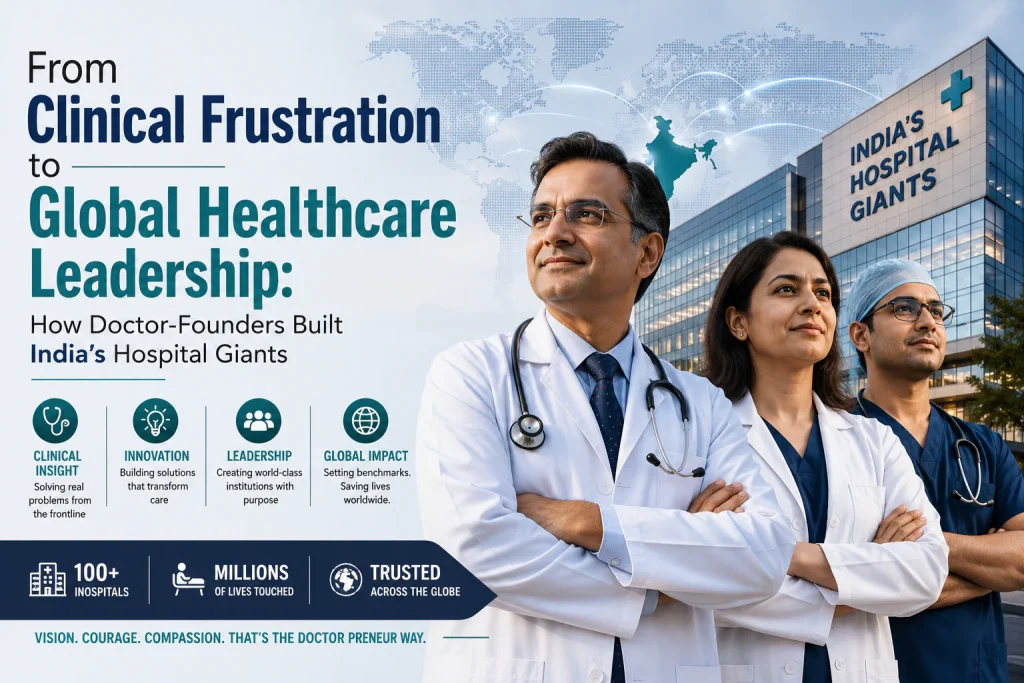
India’s private healthcare industry is now valued in the tens of billions of dollars, and several of its largest hospital chains are raising capital, adding beds, or preparing public listings. Few of these institutions, however, were founded as conventional businesses. Most were founded by doctors who were frustrated by a specific, personal problem: a patient who could not be treated in time, a procedure only the wealthy could afford, or a city without a single hospital worth trusting.
This origin story, recently detailed in a Business Today deep-dive, is more than a piece of corporate history. It explains why India’s leading hospitals have earned the trust of millions of international patients, including a growing number from Nigeria, Kenya, and Tanzania, who travel to India each year for advanced, affordable medical care. Understanding where these hospitals came from helps explain why they’ve become dependable destinations for complex treatment.
A Cardiologist Who Couldn’t Send Patients Home
Apollo Hospitals, India’s first corporate hospital chain, was founded by Dr. Prathap C. Reddy, a cardiologist who had been practising in the United States before returning to India in the early 1970s. What he found troubled him. There was almost nowhere in the country equipped to perform complex heart surgery, so he was repeatedly forced to refer patients abroad.
In 1979, one such patient could not raise the money to travel in time and died at just 38. That loss is widely cited as the reason Dr. Reddy chose to build a hospital rather than continue practising abroad. At the time, no corporate hospital model existed in India. Hospitals could not secure bank loans because they weren’t recognised as an industry, and medical equipment was taxed as a luxury item. Years of advocacy followed before Apollo finally opened its doors in Chennai in 1983.
Four decades later, the group Dr. Reddy built includes more than 70 hospitals, nearly 6,000 pharmacies, and a wide network of diagnostic centres and clinics. His guiding belief, that medical spending should be seen as an investment in health rather than a cost, still shapes how the group positions itself today.
Making Heart Surgery Affordable, By Design
A similar frustration drove Dr. Devi Shetty, founder of Narayana Health. A cardiac surgeon who trained in England, Dr. Shetty returned to India in 1989 convinced that even a country as wealthy as the United States had failed to make healthcare affordable for ordinary people. His goal was specific: bring down the cost of heart care for the average Indian family.
Narayana’s first hospital opened in Kolkata in 2000 with a modest initial investment. A larger, 225-bed cardiac facility followed in Bengaluru a year later. The model relied on volume and standardization performing a high number of surgeries with tightly managed processes to reduce the cost per procedure. As a result, heart surgery that can cost upwards of ₹30 lakh in the United States is now performed at Narayana for between ₹1 lakh and ₹2 lakh.
As Dr. Shetty puts it, “when the sea level rises, big ships go up, and so do the small boats” a description of how rising overall healthcare demand in India lifted hospitals of every size. Narayana now operates 42 facilities and has expanded internationally, including a 2025 acquisition of a UK hospital group, extending a cost-efficient care model built originally for Indian patients to international markets as well.
Why This History Matters for Patients Abroad
For patients in Nigeria, Kenya, and Tanzania weighing where to seek treatment, this origin story carries practical weight. Hospitals founded by doctors solving real clinical gaps were built around patient outcomes first, and business considerations second. That founding philosophy has persisted even as these institutions have scaled into large, professionally managed corporate networks.
This matters because it explains three things international patients consistently report about care in India: the emphasis placed on clinical outcomes and specialist expertise, the deliberate design of hospitals around affordability without compromising on treatment quality, and the scale of experience these institutions carry, built from decades of treating high volumes of complex cases.
Different Founders, One Shared Instinct
Not every hospital chain in India followed the same model, but a similar instinct runs through nearly all of them: a doctor noticing a gap in care, and choosing to build the institution needed to close it.
Dr. Naresh Trehan, founder of Medanta, returned to India after nearly 20 years in the US with a vision centered on integration combining advanced clinical care, medical education, and research under one roof, rather than simply adding hospital beds.
Dr. Dharminder Nagar, founder of Paras Health, identified a different gap entirely: North India outside major metros, a region home to roughly 60 percent of the country’s population but a much smaller share of its organised healthcare capacity. His first hospital opened in Gurugram in 2006 with 200 beds, at a time when the largest existing hospital in the city had only 30. Paras has since expanded into smaller cities most large chains still avoid, including Patna, Darbhanga, and Srinagar.
Dr. Ranjan Pai transformed Manipal Hospitals from a single institution into one of India’s largest private healthcare networks through acquisitions and professional management, while Dr. Ramesh Kancharla built Rainbow Children’s Hospital around a conviction that pediatric care required dedicated infrastructure rather than scaled-down adult facilities. Dr. Aashish Chaudhry, representing a younger generation of doctor-founders, built Aakash Healthcare in Delhi around advanced clinical technology and patient experience, later becoming the first Indian hospital brand to acquire and operate a hospital overseas.
Each of these founders solved a different problem, in a different region, for a different kind of patient. What they share is the same underlying pattern: institutions built first to solve a medical gap, and only later scaled into large healthcare businesses.
What This Means for Medical Travel from East and West Africa
India’s position as a leading destination for medical tourism is not accidental. It is the product of four decades of hospital-building by clinicians who prioritized outcomes, invested in specialist training, and gradually built the infrastructure needed to treat complex conditions at scale and at a fraction of Western costs.
For patients from Nigeria, Kenya, and Tanzania, this translates into real, practical advantages. Hospitals like Apollo, Narayana Health, Medanta, and Manipal are not simply large they are institutions built specifically around treating difficult cases affordably, a mission that has remained central to their identity even as they’ve grown into some of the largest healthcare networks in the world. Patients gain access to internationally accredited facilities, specialists with decades of high-volume surgical experience, and treatment costs that remain significantly lower than equivalent care in the US, UK, or Gulf countries.
This is also why medical assistance and facilitation matter. With dozens of major hospital chains, hundreds of specialists, and a wide range of treatment costs across India, choosing the right hospital and doctor for a specific condition can be difficult to navigate from abroad.
Humane Healthcare, based in India, has spent years helping patients from Kenya, Nigeria, Tanzania, Uganda, Ethiopia, Sudan, and Rwanda navigate exactly this landscape. Partnered with many of India’s leading, doctor-founded hospital networks, Humane Healthcare coordinates hospital and specialist selection, appointment scheduling, travel, accommodation, and post-treatment recovery support, giving patients direct access to the same institutions built by the doctors described above.
Frequently Asked Questions
Why were India’s largest hospitals founded by doctors instead of businesspeople?
Most of India’s major hospital chains, including Apollo, Narayana Health, and Medanta, were founded by doctors who had personally encountered gaps in India’s healthcare system, such as a lack of complex surgical care or unaffordable treatment costs, and built hospitals specifically to close those gaps.
Is it safe for patients from Nigeria, Kenya, and Tanzania to get treated at Indian hospitals?
Yes. India’s leading private hospitals are internationally accredited and are staffed by specialists with decades of high-volume clinical experience. Many of these hospitals were specifically built around advanced, outcome-focused patient care.
Why is treatment in India cheaper than in the US, UK, or Gulf countries?
Several major Indian hospital chains, particularly Narayana Health, were deliberately designed around high procedure volumes and standardized processes to significantly reduce the cost per treatment, without compromising on clinical quality.
Which Indian hospital chains are most commonly used by international patients from Africa?
Apollo Hospitals, Narayana Health, Medanta, and Manipal Hospitals are among the most widely used by international patients, offering advanced cardiac, oncology, orthopedic, and multi-specialty care.
How can patients from Nigeria, Kenya, or Tanzania access these hospitals?
Medical assistance companies such as Humane Healthcare help coordinate hospital and doctor selection, appointment scheduling, travel, accommodation, and recovery support for patients travelling to India for treatment.