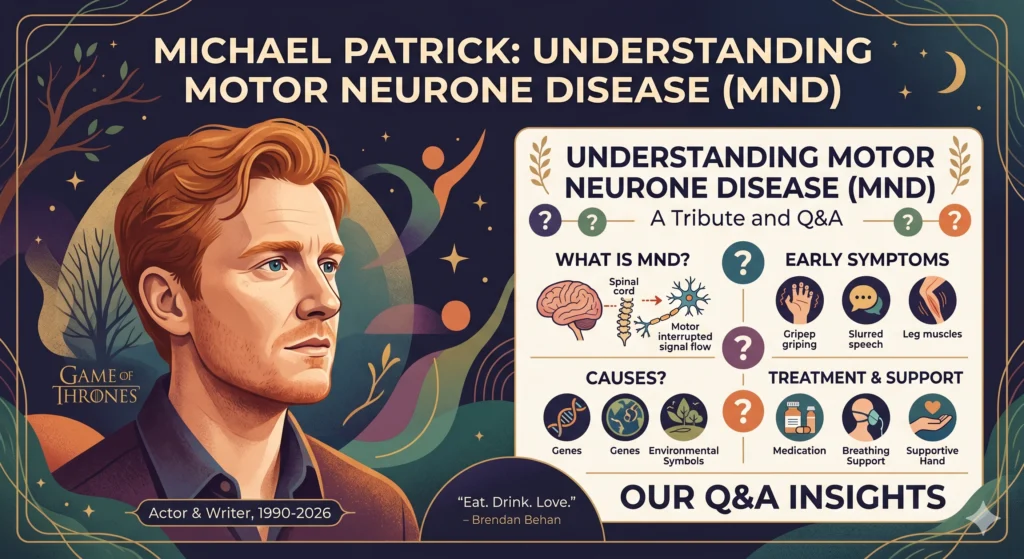
Fans and the global entertainment community mourn the tragic, untimely passing of actor and writer Michael Patrick. International audiences knew him best for his role in the hit series Game of Thrones. Patrick died at just 35 years old. He fought a relentless and challenging battle with Motor Neurone Disease (MND).
His wife, Naomi Sheehan, confirmed the devastating news. In an emotional tribute, she shared that Michael passed away peacefully on April 8, 2026. Family and friends surrounded him at the Northern Ireland Hospice. He received specialized care there for ten days before his death.
The Harsh Realities of Healthcare Shortages
Doctors formally diagnosed Michael with MND on February 1, 2023. Over three years, he documented his battle using raw honesty and trademark humor. His final social media post highlighted a harrowing reality. Patients face severe systemic issues alongside physical illness.
He bravely decided to forgo a tracheostomy, a surgical procedure to assist his breathing. A severe lack of healthcare staffing forced this heartbreaking choice. Having the surgery meant remaining in the hospital for 6 to 12 months. He chose to avoid this so he could return home to his loved ones.
A Legacy of Spirit and Support
Despite a grim prognosis from neurologists, Michael lived with abundant spirit. Friends set up a GoFundMe campaign to support his intensive medical needs. They set a £100,000 goal. The campaign ultimately raised over £110,000. This massive support proves his profound impact on others.
In her poignant tribute, Naomi Sheehan called him “a titan of a ginger-haired man.” She included a Brendan Behan quote he lived by: “The most important things to do in the world are to get something to eat, something to drink and somebody to love you. So, don’t overthink it. Eat. Drink. Love.”
Understanding the Disease
Michael’s passing triggered an outpouring of grief. It also sparked a massive wave of public inquiry. People globally use search engines to understand this brutal disease. We compiled a comprehensive Q&A blog to honor his memory. Here are answers to the most frequently asked Google questions regarding Motor Neurone Disease.
What exactly is Motor Neurone Disease (MND)?
Motor Neurone Disease (MND) is not a single illness. Instead, the term describes a rare group of rapidly progressive, fatal neurological disorders. These conditions systematically attack and destroy motor neurons. Motor neurons are specialized nerve cells in the brain and spinal cord. Their primary job involves sending electrical commands to the body’s voluntary muscles. We consciously control these muscles to walk, talk, swallow, chew, breathe, and grip objects.
When a person develops MND, these motor neurons degenerate and die. This breaks down the communication highway between the brain and the muscles. Without vital signals, muscles remain inactive. Over time, this lack of use weakens and stiffens the muscles. They eventually waste away through a process called muscle atrophy. Amyotrophic Lateral Sclerosis (ALS) is the most common subtype. In the United States, people often call it Lou Gehrig’s disease.
What are the first signs and early symptoms of MND?
MND can originate in different groups of motor neurons. Therefore, early symptoms vary wildly from person to person. The gradual onset makes immediate identification difficult. Common early warning signs include:
- Limb Weakness: A person might experience a weakened grip. This makes opening jars, turning keys, or buttoning a shirt difficult. Leg weakness can also cause frequent tripping or “foot drop.”
- Speech and Swallowing Difficulties: About a quarter of patients experience bulbar onset. They first notice speech changes. Their voice may become slurred, faint, or nasal. They might also choke easily when eating or drinking.
- Muscle Fasciculations and Cramps: Patients often endure severe, painful muscle cramps. They may also notice visible, involuntary twitching under the skin. These fasciculations commonly affect the arms, legs, or tongue.
- Emotional Lability: Some patients experience the pseudobulbar affect. This lesser-known symptom causes sudden, uncontrollable urges to cry or laugh in inappropriate situations.
What actually causes Motor Neuron Disease? Is it genetic?
Despite decades of research, the exact cause remains largely a mystery. Doctors classify about 90% to 95% of cases as “sporadic.” This means the disease strikes at random. There is no clear triggering event, environmental exposure, or known family history. Researchers hypothesize that sporadic MND results from complex interactions. Subtle genetic susceptibilities, environmental toxins, viral infections, and premature cellular aging likely play a role.
The remaining 5% to 10% of cases are “familial” or inherited. Specific genetic mutations pass the disease down through generations. Scientists link several gene mutations to familial MND. The C9orf72 and SOD1 genes are the most common culprits. If a parent carries a mutated gene, their child has a 50% chance of inheriting it.
How do doctors diagnose Motor Neuron Disease?
No single blood test, scan, or procedure definitively diagnoses MND. Instead, doctors rely on a “diagnosis of exclusion.” They conduct a battery of tests to rule out other neurological conditions. Multiple Sclerosis, pinched nerves, or heavy metal toxicity can mimic MND symptoms. A neurologist typically performs:
- Electromyography (EMG): Doctors insert tiny needles into the muscles. This evaluates electrical activity and detects motor neuron damage.
- Nerve Conduction Studies (NCS): This test measures how fast electrical signals move through nerves.
- MRI Scans: Doctors use these to rule out brain tumors, spinal cord compression, or strokes.
- Lumbar Puncture (Spinal Tap): Doctors analyze cerebrospinal fluid to check for infection or inflammation.
- Blood and Urine Tests: These tests help eliminate heavy metal poisoning or autoimmune conditions.
Is Motor Neuron Disease painful?
MND does not directly damage sensory nerves. Therefore, it does not cause a direct loss of feeling. The nerve death itself is painless. However, the secondary effects cause incredible pain. As muscles waste away, joints lose crucial support. Patients experience severe joint pain, stiffness, and aching. Profound immobility in later stages causes painful pressure sores. Regular turning prevents these sores. Furthermore, severe muscle cramps and spasms cause significant agony. Doctors manage this pain using physical therapy, specialized mattresses, and muscle-relaxing medications.
Is there a cure for MND, and what are the current treatments?
Tragically, Motor Neurone Disease currently has no cure. The resulting neurological damage is irreversible. However, “incurable” does not mean “untreatable.” Modern medicine offers a multidisciplinary approach to manage symptoms. Treatments extend survival and improve quality of life. Medical care involves:
- Disease-Modifying Medications: Drugs like Riluzole (Rilutek) and Edaravone (Radicava) modestly slow disease progression. They can extend life by a few months. Doctors also utilize newer genetic therapies like Tofersen for specific SOD1 mutations.
- Respiratory Support: Weakening diaphragm muscles make breathing difficult. Patients use non-invasive ventilation, like BiPAP machines, to breathe at night. In later stages, surgeons can perform a tracheostomy to connect a mechanical ventilator.
- Nutritional Support: Swallowing eventually becomes dangerous. Surgeons insert a PEG (Percutaneous Endoscopic Gastrostomy) tube into the stomach. This ensures patients receive adequate nutrition and hydration.
- Assistive Technology: Speech therapists introduce vital communication aids. These range from simple voice amplifiers to advanced eye-tracking computers. This technology allows fully paralyzed patients to communicate.
What is the life expectancy for someone diagnosed with MND?
MND is ultimately a fatal disease. Respiratory failure usually causes death when breathing muscles fail. Because the disease varies wildly, life expectancy depends on the specific subtype. Individual progression rates also play a huge role. For ALS, the most common form, life expectancy is unfortunately short. Most patients live two to five years after symptoms begin. However, the disease defies rigid timelines. Approximately 20% of patients live for five years. Ten percent survive for a decade. A very small fraction, around 5%, live for 20 years or more.
How does MND affect the brain, intellect, and personality?
Historically, experts believed MND left the mind completely untouched. They thought it only destroyed the body. Many patients do retain full cognitive function and memories until the end. However, modern research shows this isn’t always true. Up to 50% of people with MND experience mild cognitive and behavioral changes. They may struggle with planning, multitasking, or finding words. Furthermore, about 10% to 15% of patients develop Frontotemporal Dementia (FTD). FTD causes profound personality changes. It leads to apathy, impulsive behavior, loss of empathy, and declining language skills.
How can society better support those living with MND?
Supporting an MND patient requires a village. Practically, families need immense financial and structural backing. They must heavily modify homes with ramps, stairlifts, and accessible bathrooms. Wheelchairs, breathing machines, and communication devices remain prohibitively expensive.
Michael Patrick’s story highlights another crucial need. Healthcare systems must maintain adequate staffing to provide home care. Patients deserve to live their final days in comfort at home. Bureaucracy and staffing shortages should not trap them in hospital wards. On a macro level, society must raise awareness and fund clinical research. Organizations like the ALS Association work tirelessly. They fund drug trials and provide essential family grants.
A Final Thought on Michael Patrick’s Legacy
Michael Patrick’s death at just 35 highlights the indiscriminate cruelty of MND. The disease ignores age, talent, and bright futures. Yet, Michael showcased immense bravery and humor despite a terminal diagnosis. He maintained a deep appreciation for life’s simple joys.
We must educate ourselves about MND and advocate for better healthcare resources. Funding neurological research brings us closer to a cure. We hope to one day write a different ending to this story. Until then, we carry forward Michael’s parting wisdom: Eat. Drink. Love.