
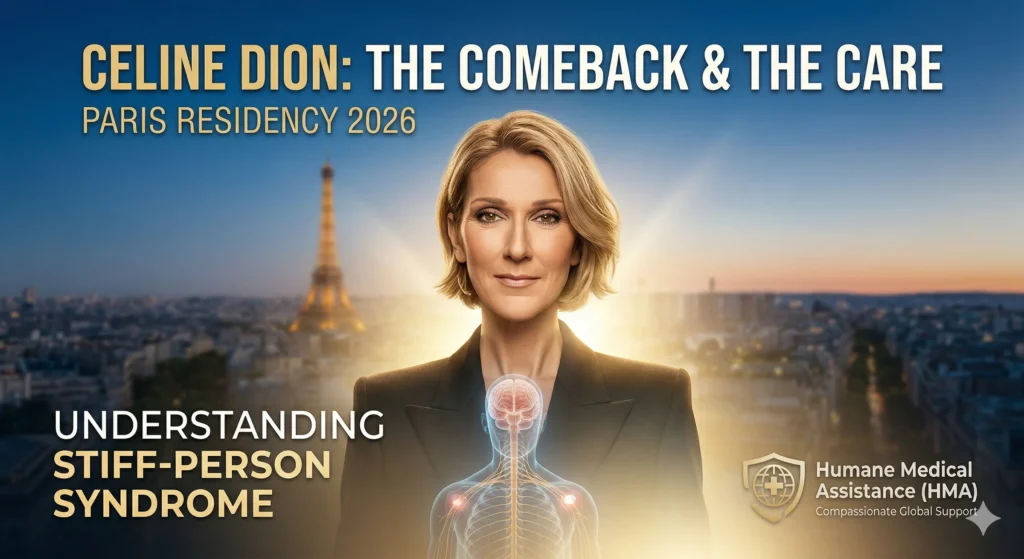
The world of music has witnessed countless spectacular comebacks, but few carry the profound emotional and medical weight of the recent announcement from Celine Dion. After a heartbreaking, multi-year hiatus, the legendary, Grammy-winning vocalist is officially returning to the stage. She has announced a five-week limited engagement residency at the Paris La Défense Arena, scheduled for the fall of 2026.
For her millions of devoted fans, this is a moment of pure, unadulterated joy. However, for the global medical community and for individuals living with chronic, debilitating illnesses, Celine’s return represents something much larger. It is a masterclass in human resilience, a testament to the advancements in symptom management, and a powerful spotlight on the realities of living with a rare, incurable condition known as Stiff-Person Syndrome (SPS).
At Humane Medical Assistance, we navigate the complexities of severe neurological and autoimmune disorders alongside our patients every single day. We understand that behind every public medical triumph is a private, grueling journey of diagnostics, specialized treatments, and relentless physical therapy. Celine Dion’s journey from a devastating diagnosis to a triumphant Paris residency underscores a critical truth: navigating a complex disease requires not just immense personal strength, but absolute access to elite, multidisciplinary medical care.
The Diagnosis That Silenced a Generation’s Voice
In December 2022, Celine Dion shared a tearful, vulnerable video message that shocked the world. She revealed that she had been diagnosed with Stiff-Person Syndrome, an exceptionally rare neurological disorder that forced her to indefinitely cancel the remainder of her Courage World Tour.
The silence that followed was heavy, broken only by occasional updates and a breathtaking, albeit brief, surprise performance at the opening ceremony of the 2024 Paris Olympics. But the release of her recent emotional video, filmed beneath the Eiffel Tower to mark her 58th birthday, changed the narrative entirely.
“Over the last few years, every day that’s gone by, I’ve felt your prayers and support,” Dion shared with her fans. “I want to let you know that I’m doing great, managing my health, feeling good… This year, I’m getting the chance to see you, to perform for you once again in Paris.”
To fully grasp the magnitude of her statement—“managing my health, feeling good”—one must first understand the devastating physical toll of the disease she is fighting.
Unmasking the Invisible Enemy: What is Stiff-Person Syndrome?
Stiff-Person Syndrome is an incredibly rare, progressive autoimmune neurological disorder. It is estimated to affect only one or two people per million. Because it is so rare, it is notoriously difficult to diagnose, often taking years and multiple specialists to identify. Patients are frequently misdiagnosed with Parkinson’s disease, multiple sclerosis, fibromyalgia, or even severe psychosomatic anxiety before a definitive answer is found.
The disease primarily affects the central nervous system—the brain and the spinal cord. It is characterized by two devastating primary symptoms:
1. Severe, Progressive Muscle Rigidity: Patients experience a profound stiffness in their muscles, most commonly starting in the torso and abdomen, and eventually spreading to the arms and legs. This stiffness can fluctuate, but it generally worsens over time, leading to a rigid posture, difficulty walking, and a high risk of dangerous falls.
2. Violent, Unpredictable Muscle Spasms: Superimposed on this constant stiffness are sudden, highly painful muscle spasms. What makes SPS particularly terrifying is the trigger mechanism for these spasms. They are often provoked by unexpected environmental stimuli: a sudden loud noise, a drop in temperature, physical touch, or even a sudden wave of emotional distress.
For a vocalist of Celine Dion’s caliber, the diagnosis is uniquely cruel. Singing at a world-class level requires absolute, microscopic control over the vocal cords, the diaphragm, and the intercostal muscles of the chest. SPS actively attacks these exact areas, causing spasms that can restrict breathing and completely paralyze the vocal mechanism.
The Reality of Treatment: A Multidisciplinary Battle
Currently, there is no known cure for Stiff-Person Syndrome. Celine Dion’s return to the stage is not the result of a miraculous overnight cure; it is the result of relentless, elite-level medical management.
Managing a progressive autoimmune neurological disorder requires an aggressive, multi-pronged approach. It takes a synchronized village of medical experts, which typically includes:
- Neurologists to monitor the progression of the disease in the central nervous system.
- Immunologists to administer therapies that suppress or modulate the overactive immune system, such as Intravenous Immunoglobulin (IVIG) or plasmapheresis.
- Pain Management Specialists to administer targeted muscle relaxants and anti-convulsants to ease the violent spasms.
- Physical and Occupational Therapists to maintain joint mobility, prevent permanent muscle contractures, and rehabilitate functional movement.
When a patient says they are “managing” a disease like SPS, it means they have dedicated their life to this rigorous medical routine, supported by the finest healthcare professionals available.
Bridging the Global Healthcare Gap
Celine Dion’s story is deeply inspiring, but it also highlights a stark disparity in global healthcare. While a global superstar has the resources to assemble a world-class team of specialists to manage a rare disease, the average person facing a complex neurological or autoimmune diagnosis often finds themselves hitting terrifying roadblocks.
Many patients around the world struggle with long wait times to see a specialist, a lack of access to advanced immunological therapies like IVIG, and the crippling financial burden of long-term specialized care. This is where the landscape of global healthcare is shifting, and why medical tourism has become a vital lifeline for thousands of patients.
You do not have to be a celebrity to deserve—and access—elite, multidisciplinary medical care.
Why India is a Premier Hub for Neurological & Autoimmune Care

At Humane Medical Assistance, we bridge the gap between international patients and the life-saving treatments they require. India has rapidly emerged as a global center of excellence for neurology, immunology, and complex disease management.
Here is why patients worldwide are looking to India’s premier healthcare infrastructure when facing daunting diagnoses:
1. Internationally Acclaimed Specialists: Hospitals in major Indian medical hubs—such as Delhi, Mumbai, Pune, and Hyderabad—are staffed by neurologists and immunologists who have trained at top institutions globally. Because of the vast population and large referral networks, these specialists possess deep clinical experience in diagnosing and managing incredibly rare conditions that doctors in smaller healthcare systems might never encounter in their entire careers.
2. Advanced, Comprehensive Infrastructure: Managing conditions like Stiff-Person Syndrome, Multiple Sclerosis, or complex spinal disorders requires a hospital that can provide everything under one roof. India’s JCI and NABH-accredited facilities offer state-of-the-art neuro-imaging, advanced pathology labs, fully equipped immunology wings for regular IVIG infusions, and dedicated neuro-rehabilitation centers.
3. Cost-Effective Access to Life-Saving Therapies: Autoimmune therapies and long-term neurological care are notoriously expensive globally. India offers a unique advantage: clinical outcomes that rival or exceed those in the West, but at a fraction of the cost. This makes high-quality, long-term disease management accessible and sustainable for international patients and their families.
Your Healthcare Partner: Humane Medical Assistance
Receiving a diagnosis for a rare, chronic, or complex condition is one of the most frightening experiences a person can endure. Trying to navigate the logistics of finding the right specialist, arranging travel, and understanding treatment plans only compounds that anxiety.
At Humane Medical Assistance, we believe that your only job should be focusing on your health and recovery. Our mission is to handle everything else. As a premier medical tourism facilitator, we provide a seamless, compassionate, and highly professional pathway to India’s top medical institutions.
Our end-to-end services include:
- Expert Second Opinions: Before you even book a flight, we connect you with top-rated Indian neurologists and specialists via online consultations to review your case and outline potential treatment protocols.
- Tailored Hospital Matchmaking: We guide you to the specific specialists and accredited hospitals best equipped to handle your precise diagnosis.
- Comprehensive Concierge Logistics: From securing your medical visa and arranging airport transfers to booking comfortable accommodations near the hospital, our team ensures your journey is entirely stress-free.
- Dedicated On-Ground Support: You are never alone. Our patient care coordinators, complete with language translation services, are by your side to help you navigate hospital admissions, specialist appointments, and therapy sessions.
Celine Dion’s highly anticipated return to the stage in Paris is a beautiful reminder that a severe diagnosis does not necessarily mean the end of the song. With profound resilience and the backing of an expert, dedicated medical team, it is possible to reclaim your life, manage your symptoms, and find your voice once more.
Are you or a loved one seeking answers, a second opinion, or advanced treatment for a complex neurological or autoimmune condition? Do not face this journey alone. Contact Humane Medical Assistance today to request a free consultation, and let us connect you with the world-class medical expertise you deserve.