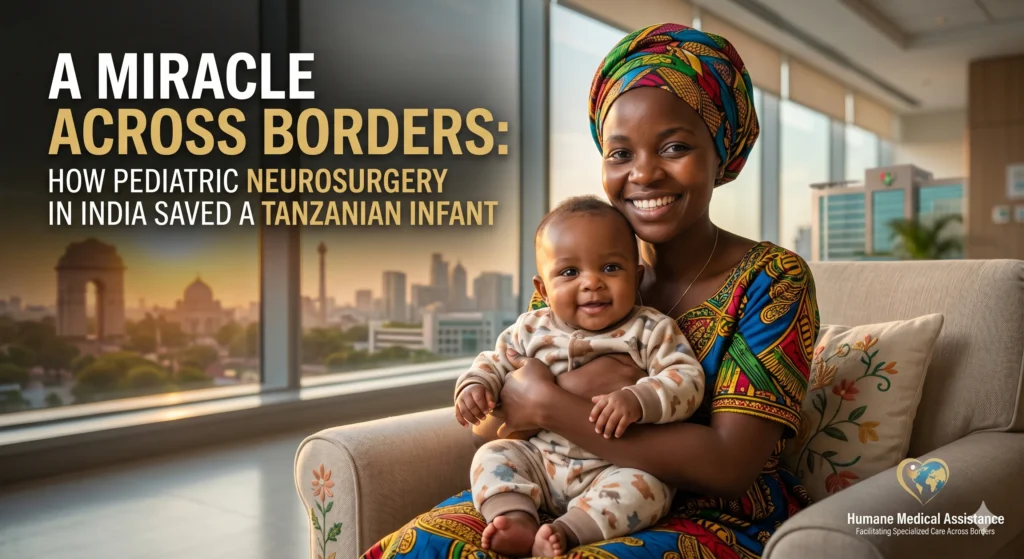
For any parent, the birth of a child brings overwhelming joy. However, when that joy is abruptly interrupted by a rare, life-threatening medical diagnosis, families are plunged into a terrifying reality. Recently, a profound story of hope emerged from New Delhi, India, highlighting a medical triumph that resonates deeply across the globe. A 5-month-old infant from Tanzania, diagnosed with a severe and rare skull deformity, successfully underwent highly complex reconstructive brain surgery.
This incredible success story is not just a testament to the brilliance of Indian medical infrastructure. It serves as a powerful beacon of hope for international families facing impossible pediatric diagnoses.
At Humane Medical Assistance, we passionately believe that geography should never dictate a child’s chance at a healthy life. As we actively support the Tanzania Neurosurgical Society and prepare to engage with medical delegates at the upcoming National Medical Congress of Tanzania this June, stories exactly like this reinforce our core mission. Let us delve into the medical realities of this rare condition, the astonishing precision of the surgical intervention, and why India continues to stand as the ultimate sanctuary for complex pediatric care.
Understanding the Threat: Craniosynostosis and Scaphocephaly
To fully appreciate the magnitude of this medical achievement, we must first understand the severe condition threatening this young Tanzanian infant. The child was diagnosed with craniosynostosis, a rare congenital birth defect.
When a baby is born, their skull is not a single, solid piece of bone. Instead, it consists of several separate bony plates connected by flexible, fibrous joints called sutures. This incredible biological design allows the baby’s head to easily pass through the birth canal and, more importantly, gives the rapidly growing infant brain the physical space it needs to expand during the first critical years of life.
In a child with craniosynostosis, one or more of these vital sutures fuse shut prematurely. In this specific Tanzanian infant’s case, the condition manifested as scaphocephaly (sagittal synostosis). The sagittal suture, running along the top of the head from front to back, fused entirely too early.
Consequently, as the infant’s brain naturally attempted to grow, it could no longer expand sideways. Instead, the brain was forced to push outward against the front and back of the skull. This resulted in an abnormally long, narrow head shape. Beyond the physical deformity, the true danger lies beneath the bone. If left untreated, this severe restriction actively prevents normal brain development, leading to intense intracranial pressure, severe cognitive impairment, developmental delays, and potentially permanent vision loss. Immediate, highly specialized intervention was the absolute only option.
The Complexity of the Cure: Cranial Vault Remodeling
Correcting craniosynostosis requires far more than standard surgery. It demands an incredibly complex, high-risk procedure known as cranial vault remodeling, and in this specific instance, a highly advanced variation called a modified pi-plasty.
You cannot simply “un-fuse” the bone. The neurosurgical team must physically dismantle the fused sections of the infant’s skull and meticulously reconstruct them. They must artificially create the essential space the growing brain desperately requires.
Performing this on a 5-month-old infant introduces immense clinical challenges. Infants possess a very small total blood volume. Even minimal blood loss during a major cranial reconstruction can trigger a catastrophic medical crisis instantly. Furthermore, the anesthesiologist must maintain absolute, flawless control over the infant’s delicate respiratory and circulatory systems throughout the prolonged procedure.
Because of these extreme risks, this surgery absolutely cannot be performed by a single doctor. It requires a massive, perfectly synchronized multidisciplinary team. The operating room must contain elite pediatric neurosurgeons, specialized craniofacial plastic surgeons, highly trained pediatric neuro-anesthesiologists, and a dedicated pediatric intensive care unit (PICU) team waiting on standby. This level of comprehensive, advanced medical infrastructure is rare, but it is exactly what top-tier Indian corporate hospitals provide daily.
The Delhi Miracle: A Three-Day Journey to a New Life

The Tanzanian family, seeking the absolute best care for their child, traveled thousands of miles to BLK-Max Super Speciality Hospital in New Delhi. Under the expert guidance of Dr. Rohit Bansil, Director of Neurosurgery, and his extensive multidisciplinary team, the infant underwent the high-stakes modified pi-plasty.
The surgical team flawlessly executed the intricate skull reconstruction. They successfully expanded the cranial vault, instantly relieving the dangerous pressure on the infant’s developing brain. Post-operative imaging immediately confirmed that the brain now had the critical space required for normal, healthy growth.
However, the true miracle of this story lies in the recovery. Following a massive, physically traumatic brain and skull reconstruction, one would naturally expect an infant to spend weeks fighting for their life in an intensive care unit.
Instead, thanks to the absolute precision of the surgical technique and the world-class supportive care provided by the pediatric ICU team, the infant stabilized with astonishing speed. In a testament to India’s elite medical capabilities, the baby was discharged from the hospital just three days after the complex surgery.
For international parents who are naturally terrified of navigating prolonged, complicated medical recoveries in a foreign country, a three-day discharge represents the ultimate reassurance. It proves that advanced surgical precision directly translates to safer, faster, and less traumatic healing for their children.
Why Tanzanian and African Families Choose India for Pediatric Care
This inspiring success story is not an isolated event. It is a powerful reflection of a deeply established medical corridor. Thousands of families from Tanzania, Cameroon, and across the African continent confidently choose India when faced with severe, life-threatening pediatric diagnoses.
1. Unmatched Multidisciplinary Infrastructure As demonstrated by the BLK-Max hospital case, treating complex pediatric conditions requires a village of specialists. Indian JCI-accredited hospitals are specifically designed to foster this multidisciplinary approach. Pediatric neurosurgeons, plastic surgeons, and specialized ICU teams operate seamlessly under one roof, guaranteeing comprehensive, holistic care for every child.
2. Globally Renowned Medical Expertise Indian pediatric specialists process an incredibly high volume of complex cases. Consequently, their hands-on clinical experience often far surpasses that of doctors in many Western nations. They routinely handle rare congenital defects, complex brain tumors, and severe neurological disorders with exceptionally high success rates.
3. Compassionate, Highly Affordable Care A surgery as complex as cranial vault remodeling costs an astronomical fortune in the United States or Europe, often placing it entirely out of reach for international families. India fundamentally disrupts this barrier. Indian hospitals provide the exact same elite standard of surgical care, utilizing the exact same FDA-approved technologies and implants, at a mere fraction of the global cost. India ensures that financial constraints do not stand in the way of a child’s life-saving treatment.
Let Humane Medical Assistance Bridge the Gap
When a doctor delivers a severe pediatric diagnosis, panic instantly sets in. The prospect of organizing international medical travel, securing visas, and finding the right surgeon while caring for a critically ill infant feels like an impossible, insurmountable mountain.
You do not have to climb that mountain alone.
At Humane Medical Assistance, we serve as your dedicated, deeply compassionate healthcare facilitation partner. We understand the specific cultural and logistical needs of our international patients, and we expertly remove every single barrier between your child and the life-saving care they need.
How We Facilitate Your Child’s Journey to Health:
- Elite Surgeon Selection: We bypass the confusion and connect your family directly with India’s absolute best, proven pediatric neurosurgeons and specialized craniofacial teams.
- Rapid Medical Visas & Logistics: When a child’s brain is under pressure, every day counts. We expedite the complex medical visa process and flawlessly coordinate all airport transfers and ground logistics.
- Safe, Comfortable Accommodations: We secure highly sanitary, comfortable, and private local housing specifically suited for families recovering from major pediatric procedures.
- Transparent, Negotiated Financials: We aggressively advocate on your behalf to secure highly transparent, cost-effective treatment packages, ensuring no hidden fees compound your stress.
- Relentless Patient Advocacy: Our dedicated patient coordinators remain by your side in India 24/7. We manage the hospital bureaucracy so you can focus entirely on holding and comforting your child.
The story of the Tanzanian infant in New Delhi proves that congenital defects and rare diseases do not have the final word. Advanced medical science, flawless surgical execution, and dedicated international coordination can rewrite a child’s future.
Do not let fear or geography delay your child’s treatment. Contact Humane Medical Assistance today. Let us expertly facilitate your journey across borders, guiding your family toward world-class pediatric care and a long, healthy life for your child.