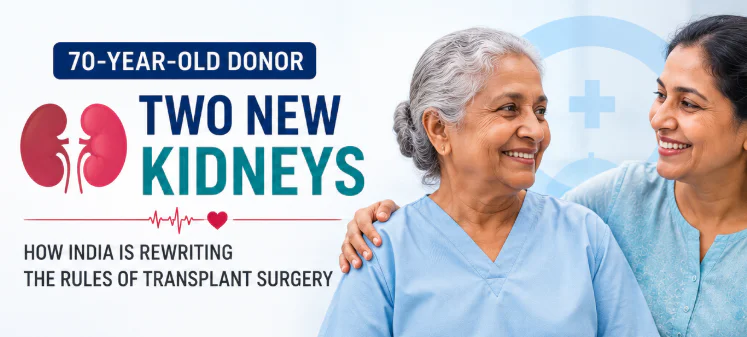
When a 70-year-old woman was declared brain-dead at Command Hospital in Chandigarh, many would assume her organs were too old to save a life. However, top transplant surgeons in India saw a profound opportunity instead. On July 28, 2026, a medical team loaded her kidneys onto an Army helicopter and rushed them to the All India Institute of Medical Sciences (AIIMS) in New Delhi.
There, an elite surgical team performed a rare and complex “dual kidney transplant.” Because of the donor’s advanced age, surgeons successfully implanted both kidneys into a single 56-year-old female recipient. Despite spending nearly 12 hours outside the body in cold ischemia, the kidneys began functioning immediately. Just 10 days later, the recipient walked out of the hospital with completely normal kidney function.
This historic achievement at AIIMS Delhi is more than just a heartwarming story. Indeed, it highlights the sheer surgical mastery, rapid logistics, and medical innovation defining India’s healthcare system today. For patients suffering from end-stage renal disease across Africa, Uzbekistan, Russia, and the Middle East, stories like this confirm exactly why India is the ultimate global destination for life-saving kidney transplants.
At Humane Medical Assistance, based right here in New Delhi, we coordinate these life-altering medical journeys every day. Today, we will explore the science behind this incredible transplant, explain India’s legal landscape for international patients, and break down why cross-border healthcare is your best path to recovery.
The Science of Dual Transplants and “Marginal Donors”
To fully appreciate the AIIMS Delhi success story, we must understand the medical concept of an “expanded criteria donor” or a “marginal donor.”
Traditionally, medical protocols favored organs from young, completely healthy individuals. However, a global shortage of organs forces surgeons to innovate constantly. Therefore, a marginal donor includes individuals over the age of 60 or those with minor, manageable medical histories.
Normally, a human only needs one healthy kidney to live. However, when doctors retrieve kidneys from a 70-year-old donor, a single kidney might lack the functional reserve to support the recipient completely. To solve this problem, surgeons like Prof. Asuri Krishna at AIIMS utilize a brilliant strategy: the dual kidney transplant. By implanting both older kidneys into one recipient, the combined filtration power equals that of a young, single kidney.
Consequently, this strategy maximizes the organ pool dramatically. It ensures that no potentially usable organ ever goes to waste simply because of the donor’s chronological age.
The Reality for International Patients: Understanding the Law
The AIIMS Delhi story features a deceased donor (cadaveric transplant). However, international patients traveling to India must understand a crucial legal distinction.
Under the Transplantation of Human Organs and Tissues Act (THOTA), foreign nationals cannot receive organs from deceased Indian citizens. Deceased donor organs strictly go to Indian nationals on the national waiting list. Furthermore, commercial organ trading is strictly illegal.
Therefore, international patients must bring a living related donor from their home country. The donor must be a close blood relative (parent, child, sibling, grandparent) or a spouse.
While you cannot receive a deceased donor organ in India, the AIIMS story directly benefits you. Why? Because the exact same surgical teams, utilizing the exact same cutting-edge microvascular techniques and immunosuppressive protocols, handle living donor transplants in India’s top corporate hospitals.
If Indian surgeons can successfully manage a 12-hour cold ischemia time for an elderly deceased donor, imagine the exceptional success rates they achieve with a planned, perfectly timed living donor surgery involving a healthy relative.
Why Global Patients Choose India for Kidney Transplants
End-stage renal disease (ESRD) requires immediate, definitive action. Dialysis keeps patients alive, but it severely limits their quality of life. Therefore, thousands of patients look beyond their borders every year to secure a permanent cure.
Here is exactly why India leads the world in living donor kidney transplantation:
1. Unmatched Surgical Volume and Expertise
High surgical volume directly produces superior clinical outcomes. Indian nephrologists and transplant surgeons perform thousands of successful kidney transplants annually. Consequently, they possess unmatched expertise in complex cases, including ABO-incompatible transplants (where the donor and recipient have different blood types). Their ability to manage post-operative care and precisely balance anti-rejection medications is world-class.
2. Advanced Minimally Invasive Technology
Today, removing a kidney from a healthy living donor no longer requires a massive, painful incision. Indian corporate hospitals utilize 3D laparoscopic and Da Vinci robotic surgical systems for donor nephrectomies. As a result, the donor experiences minimal scarring, significantly less pain, and a rapid recovery—often leaving the hospital in just 3 to 4 days.
3. The Incredible Cost Advantage
In the United States, a kidney transplant can easily cost over $400,000. For most global citizens, that price is utterly impossible. In stark contrast, Indian JCI-accredited hospitals perform the exact same procedure for a fraction of the cost. The financial burden drops dramatically without ever compromising on clinical excellence, safety protocols, or hospital infrastructure.
Key Insight: Even when you factor in flights, extended accommodation, and the first year of immunosuppressive medications, a transplant in India remains profoundly more affordable than Western alternatives.
4. Zero Wait Times for Scheduled Surgeries
When kidneys fail, time becomes your most precious resource. In many nations, navigating the medical bureaucracy takes agonizing months. However, private healthcare in India moves with incredible speed. Once Humane Medical Assistance helps clear your legal documentation, you can schedule your transplant surgery almost immediately.
Tailored Medical Journeys for Specific Regions
At Humane Medical Assistance, we know that patients from different regions face unique logistical and cultural challenges. Therefore, we customize our medical concierge services to meet your exact needs.
For Patients from Africa (Nigeria, Kenya, Tanzania, Ethiopia)
Access to advanced transplant infrastructure remains scarce in many African countries. Furthermore, managing long-term immunosuppression requires expert guidance. We connect African patients directly with India’s top transplant centers. We handle complex medical visa processing, arrange safe airport ambulance transfers, and secure comfortable, budget-friendly service apartments near the hospital. As a result, you and your donor feel completely secure during your extended recovery.
For Patients from the CIS Region (Uzbekistan, Russia)
Patients in Uzbekistan and Russia frequently seek the advanced robotic surgical technology available in India. However, the language barrier creates massive anxiety. We solve this problem entirely. Humane Medical Assistance provides dedicated, medically trained Russian-speaking interpreters for all our CIS patients. Your interpreter stays beside you during every consultation, ensuring you completely understand your surgical plan and medication schedule. Thus, we eliminate all dangerous medical miscommunications.
For Patients from the Middle East (UAE, Oman, Saudi Arabia, Iraq)
Middle Eastern patients demand the highest levels of privacy, veteran surgical expertise, and culturally respectful care. We facilitate luxurious VIP hospital suites to guarantee your comfort. Additionally, we ensure strict adherence to all Halal dietary requirements throughout your stay. With fluent Arabic-speaking coordinators on our team, Middle Eastern patients enjoy a deeply respectful and seamless healthcare experience in New Delhi.
The Humane Medical Assistance Process
Navigating international transplant laws and medical logistics feels overwhelming. We exist to carry that heavy burden for you. Here is how we ensure a flawless journey:
- Pre-Evaluation and Treatment Planning: You send us the medical reports for both the patient and the proposed living donor. We consult with top Indian nephrologists and provide a clear, transparent cost estimate and treatment roadmap.
- Legal Documentation Assistance: The Indian government stringently verifies the relationship between the donor and recipient to prevent organ trafficking. We guide you step-by-step through the required embassy attestations, DNA testing, and Authorization Committee paperwork.
- Visas and Logistics: We provide official Visa Invitation Letters to expedite your medical visas. We manage all ground transportation and book verified, hygienic accommodations suited for a transplant recovery.
- 24/7 Ground Support: From hospital admission to your final discharge, our dedicated Case Managers remain by your side.
- Post-Transplant Care: Once you fly home, we facilitate regular video consultations with your Indian surgical team to monitor your kidney function and adjust your medications safely.
FAQs
Q: Can a foreign national get a deceased donor kidney in India?
A: No. Under Indian law (THOTA), foreign nationals are strictly prohibited from receiving deceased donor organs. International patients must bring a medically compatible living related donor (a close blood relative or spouse) from their home country.
Q: Who qualifies as a living related donor for an international patient?
A: The law defines a “near relative” as a mother, father, son, daughter, brother, sister, grandfather, grandmother, grandson, granddaughter, or spouse. You must provide extensive legal documentation and DNA tests to prove this relationship to the Authorization Committee.
Q: What is the age limit for a living kidney donor in India?
A: Legally, a donor must be at least 18 years old. While younger donors are generally preferred, doctors evaluate the physiological age rather than just the chronological age. Healthy adults in their 50s or 60s can successfully donate if they pass rigorous cardiovascular and renal health screenings.
Q: How long do I need to stay in India for a kidney transplant?
A: International patients should plan to stay in India for approximately 2 to 3 months. This timeframe covers pre-transplant legal clearances, the surgery, the hospital stay, and the critical post-operative outpatient monitoring period required to balance your new medications.
Q: Does Humane Medical Assistance help with language translation?
A: Yes, absolutely. We provide dedicated, professional medical interpreters fluent in Russian, Arabic, French, and Swahili. Consequently, you will never face a communication gap with your doctors or nurses.
Reclaim Your Health and Your Future
The groundbreaking dual transplant at AIIMS Delhi proves that Indian medical science constantly pushes the boundaries of what is possible. A kidney transplant is not just a medical procedure; it is the ultimate restoration of freedom and vitality.
You do not have to spend years tied to a dialysis machine. World-class, dignified, and highly affordable transplant care is readily available in India today.
Let Humane Medical Assistance handle the complex legal and medical logistics while you focus entirely on your recovery. Contact our New Delhi office today to discuss your medical reports and begin your journey toward a healthier, dialysis-free life.